Table of Contents
Key takeaways
- Mount Everest has two main base camps: South Base Camp in Nepal at 5,364 meters and North Base Camp in Tibet at 5,150 meters.
- The base camps serve as crucial acclimatization and preparation points for climbers before ascending to higher camps toward the summit.
- South Base Camp is accessible via a popular trek through Nepal, while North Base Camp can be reached by jeep and trek from Tibet.
- Besides the base camps, climbers use several higher camps (Camp 1 to Camp 4) to rest and adjust to altitude during their summit push
Mount Everest, the tallest mountain in the world, has two main base camps. These camps are the starting points for climbers who want to reach the summit. One base camp is in Nepal, called the South Base Camp, and the other is in Tibet, called the North Base Camp. Both camps are at high altitudes and play important roles for climbers and trekkers.
The Two Main Base Camps on Everest
South Base Camp (Nepal)
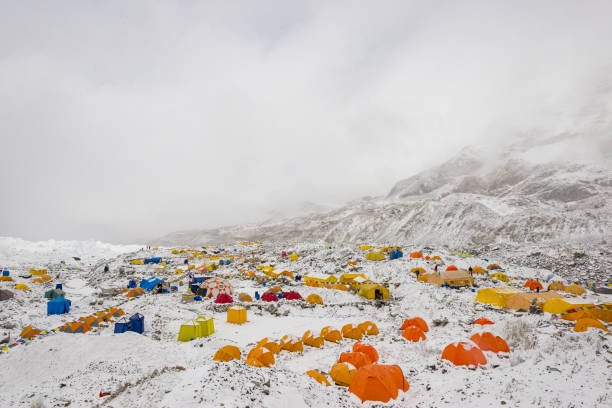
The South Base Camp is located at about 5,364 meters (17,598 feet) above sea level in Nepal. It is the most popular base camp because it is easier to reach and is part of the famous South Col climbing route. Many people trek to this base camp just to see Mount Everest up close, even if they are not climbing to the top. Climbers stay here to prepare and acclimatize before moving higher.
North Base Camp (Tibet)
The North Base Camp is found in Tibet (China) at around 5,150 meters (16,900 feet). It is less crowded than the South Base Camp but is used by climbers who take the North Col route to the summit. This camp is also a starting point for climbers and serves a similar purpose as the South Base Camp, providing a place to rest and get ready for the climb ahead.
Camps Beyond the Base Camps
Besides the two main base camps, there are several higher camps on the way to Everest’s summit. Climbers usually pass through four additional camps after leaving the South Base Camp, named Camp 1, Camp 2, Camp 3, and Camp 4. These camps help climbers rest and adjust to the altitude during their ascent. Here is a quick overview of these camps on the south side:
- Camp 1: At about 6,065 meters, a temporary resting spot after the Khumbu Icefall.
- Camp 2: Known as the “Advanced Base Camp,” located around 6,400 meters.
- Camp 3: Positioned on the Lhotse Wall at roughly 7,200 meters.
- Camp 4: Known as the “Death Zone,” found around 7,900 meters, where oxygen is very thin.
The north side also has a series of camps used by climbers following that route.
Why Are Base Camps Important?
Base camps serve several key roles:
- They act as starting points for climbers to prepare for the dangerous journey to Everest’s summit.
- Climbers use the camps to rest and adjust to high altitudes gradually, which helps reduce the risk of altitude sickness.
- Base camps provide a place for teams to organize supplies, get medical help if needed, and communicate with the outside world.
Conclusion
In summary, Mount Everest has two main base camps: the South Base Camp in Nepal and the North Base Camp in Tibet. Both camps are vital for climbers starting their journey to the summit. Beyond these, there are additional camps along the climbing routes that help climbers progress safely. Whether you are a climber or a trekker, knowing about these camps gives you a better understanding of the challenges and preparations involved in exploring the world’s highest peak.
FAQ
How many base camps are there on Mount Everest?
There are two main base camps on Mount Everest: the South Base Camp in Nepal and the North Base Camp in Tibet. These are the starting points for climbers attempting to reach the summit.
What is the altitude of the South Base Camp?
The South Base Camp is located at about 5,364 meters (17,598 feet) above sea level in Nepal.
What is the altitude of the North Base Camp?
The North Base Camp in Tibet is situated at approximately 5,150 meters (16,900 feet) above sea level.
Can tourists visit the base camps without climbing Everest?
Yes, many trekkers and tourists visit both base camps to experience the spectacular views and the environment without climbing to the summit.
Are there accommodations available at the base camps?
Basic accommodations, such as teahouses, are available near the South Base Camp, while climbers typically use tents at higher camps. Infrastructure at the camps is temporary and set up each climbing season.
What is the purpose of the base camps?
Base camps serve as crucial acclimatization and preparation points for climbers, providing a place to rest, organize supplies, get medical aid, and adjust to high altitudes before ascending further.
Are there other camps beyond the base camps on the way to the summit?
Yes, there are several higher camps named Camp 1, Camp 2, Camp 3, and Camp 4 on the south side (and similarly named camps on the north side) that climbers use as they move toward the summit.
Do climbers need permits to visit base camps?
Yes, permits are required for trekking to Everest Base Camp, including national park permits and other trekking permissions depending on the route and nationality.
When is the best time to visit Everest Base Camp?
The best times to visit are during the pre-monsoon (spring) season from March to May and the post-monsoon (autumn) season from September to November, when weather conditions are more stable.
Is trekking to Everest Base Camp dangerous?
Trekking to the base camps is generally safe if proper acclimatization is followed, but risks like altitude sickness, unpredictable weather, and physical exertion exist.
What kind of gear is needed for the trek to base camps?
Essential gear includes warm clothing, sturdy hiking boots, sleeping bags, and trekking poles. More specialized climbing equipment is required if ascending beyond the base camps.