Key Takeaways
- The standard Everest Base Camp Trek takes 12 to 15 days from Lukla covering 130 km round trip with 2 mandatory acclimatization days at Namche Bazaar (3,440 m) and Dingboche (4,410 m) that cannot be skipped without serious altitude sickness risk
- Trekkers walk 8 to 16 km per day for 5 to 7 hours with the longest single day being the Namche to Lukla return at 15 km in 7 to 8 hours and the most demanding being the Lobuche to Gorak Shep to EBC day at 15 km in 7 to 8 hours at maximum altitude
- The helicopter return option cuts the trek to 9 to 11 days total by replacing the 3-day walking descent with a 45-minute flight from Gorak Shep to Kathmandu at a cost of USD 2,055 to USD 3,199 per person in 2025
- Lukla flight cancellations due to mountain weather affect most treks at some point and every itinerary requires 2 to 3 buffer days at the Lukla end to prevent missed international connections
Table of Contents
The Everest Base Camp Trek takes 12 to 15 days on the standard walking itinerary from Lukla. The full round trip covers 130 km from Lukla to Everest Base Camp at 5,364 meters and back. Trekkers walk 8 to 16 km per day and spend 5 to 7 hours on the trail each day. Two mandatory acclimatization days at Namche Bazaar and Dingboche are built into every safe itinerary and cannot be skipped.
How Long Is the Everest Base Camp Trek? The Short Answer
The standard Everest Base Camp Trek takes 12 to 15 days from Lukla to Lukla. Add 2 days for flights between Kathmandu and Lukla and the total trip from arrival to departure in Nepal runs 14 to 16 days. Trekkers who choose the helicopter return option complete the same route in 9 to 11 days total.
Standard Duration – 12 to 15 Days from Lukla
The 130 km round trip from Lukla to Everest Base Camp and back divides into 9 days of ascent and 3 days of descent on the standard walking itinerary. Two acclimatization days are included in the 12 to 15 day count. Without those rest days the trek cannot be safely completed by most trekkers. Rushing the ascent is the single most common reason trekkers turn back before reaching Base Camp.
Total Distance – 130 km Round Trip
The Lukla to Everest Base Camp route covers 65 km one way. The return covers the same 65 km in the opposite direction. Daily distances range from 8 km on acclimatization days to 16 km on longer descent days. The average distance per walking day is 10 to 12 km. Distance numbers alone do not capture the true effort because the elevation gain above 4,000 meters makes even short distances physically demanding.
Day by Day Time Breakdown – Standard 14-Day Itinerary
Day 1 to 2 – Kathmandu to Lukla to Phakding
Day 1 is the arrival day in Kathmandu at 1,350 meters. No trekking happens on this day. Day 2 starts with a 35-minute mountain flight from Kathmandu to Lukla at 2,860 meters on the Tenzing-Hillary Airport, one of the most dramatic airstrips in the world. Understanding where the Everest Base Camp trek starts helps with planning. From Lukla, trekkers walk 9 km downhill to Phakding at 2,610 meters in 3 to 4 hours. Day 2 is the only day on the ascent that involves net elevation loss.
Day 3 – Phakding to Namche Bazaar
Phakding to Namche Bazaar covers 10.4 km in 5 to 6 hours. The trail gains 830 meters of elevation. The route crosses multiple suspension bridges over the Dudh Koshi River and enters Sagarmatha National Park at Monjo. The final 2-hour climb from the national park gate to Namche Bazaar at 3,440 meters is the steepest single ascent on the entire trek. This day consistently ranks as one of the most challenging days of the whole route.
Day 4 – Namche Bazaar Acclimatization
Day 4 is a rest day at Namche Bazaar at 3,440 meters. Trekkers do not gain sleeping altitude on this day. The recommended acclimatization hike goes up to the Everest View Hotel at 3,880 meters and back down to Namche to sleep lower. This climb-high-sleep-low pattern prepares the body for the days above 4,000 meters that follow. Namche Bazaar offers ATMs, bakeries, gear shops, and the last reliable internet connection on the trail.
Day 5 to 6 – Namche to Tengboche to Dingboche
Day 5 covers 10 km from Namche Bazaar at 3,440 meters to 3,860 meters in 5 to 6 hours. The trail passes through rhododendron and pine forest with views of Ama Dablam (6,812 m), Everest, and Lhotse opening up across the valley. Tengboche Monastery is the largest monastery in the Khumbu region and sits at the end of Day 5 with mountain views on all sides.
Day 6 moves from Tengboche at 3,860 meters to Dingboche at 4,410 meters, covering 12 km in 5 to 6 hours with 550 meters of elevation gain. Above Pangboche at 4,010 meters the trail leaves tree cover behind and enters the high alpine zone for the rest of the trek.
Day 7 – Dingboche Acclimatization
Day 7 is the second mandatory rest day at Dingboche at 4,410 meters. The recommended acclimatization hike climbs to Nagarjun Hill at 5,100 meters and returns to Dingboche to sleep. This rest day is as important as the Namche rest day. The body needs time to produce more red blood cells at this elevation before moving higher. Trekkers who skip Day 7 face significantly higher altitude sickness risk on the days above Lobuche.
Day 8 to 9 – Dingboche to Lobuche to Gorak Shep and EBC
Day 8 covers 12 km from Dingboche at 4,410 meters to Lobuche at 4,940 meters in 5 to 6 hours. The trail passes the Tukla Pass at 4,620 meters where memorials to climbers who died on Everest line the ridge. Lobuche at 4,940 meters is where altitude effects become clearly noticeable for most trekkers.
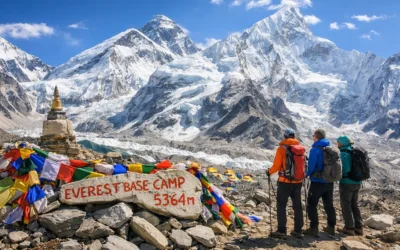
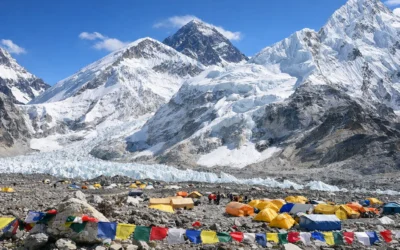
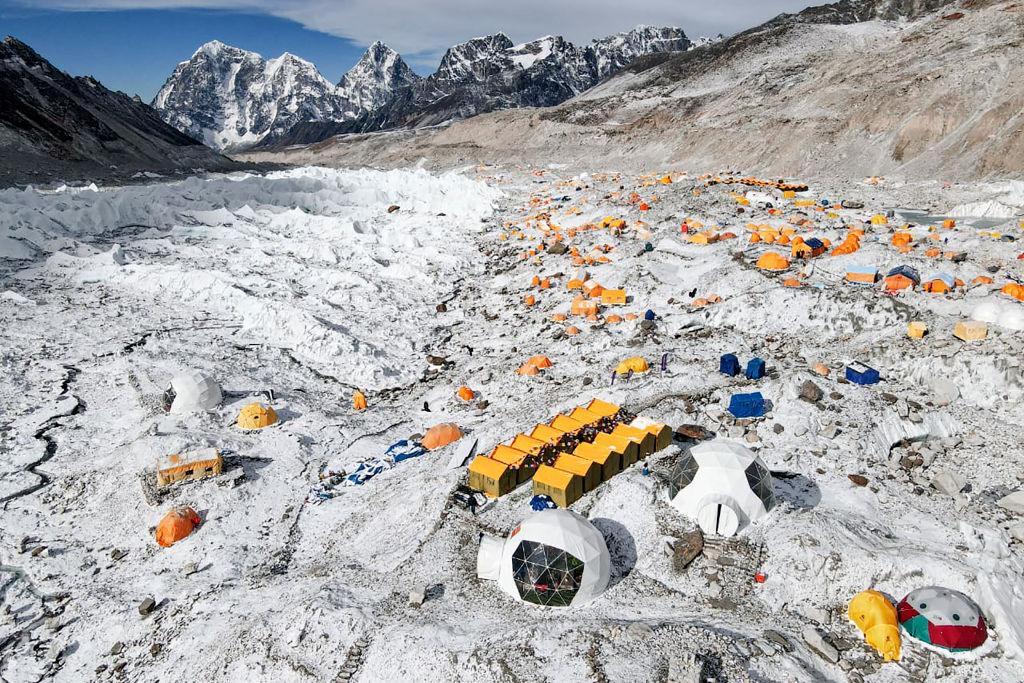
Day 9 is the most anticipated day of the entire trek. Trekkers walk from Lobuche to Gorak Shep at 5,170 meters in 3 to 4 hours, have lunch, and continue 3.5 km to Everest Base Camp at 5,364 meters. Understanding how high Everest Base Camp helps prepare mentally for this day. The total walking time on Day 9 runs 7 to 8 hours. The final approach to Base Camp crosses the Khumbu Glacier moraine, a shifting surface of rocks, ice, and glacial debris. Trekkers return to Gorak Shep to sleep.
Day 10 – Kala Patthar and the Start of Descent
Day 10 begins at 5 AM with the climb to Kala Patthar at 5,545 meters, the highest point of the entire trek and the location of the best sunrise view Everest Base Camp offers. The ascent from Gorak Shep takes 2 to 3 hours. From Kala Patthar trekkers descend all the way to Pheriche at 4,240 meters or Pangboche at 4,010 meters, covering 13 km in 7 to 8 hours. The body descends fast at altitude. Most trekkers feel significantly better the moment they drop below 5,000 meters.
Day 11 to 13 – Return to Lukla
The descent from Pheriche back to Lukla follows the same trail in reverse over 3 days. Day 11 returns to Namche Bazaar. Day 12 covers Namche to Lukla, 15 km in 7 to 8 hours, the longest walking day of the entire trek by time. Day 13 serves as a flight buffer day in Lukla because Lukla airport cancellations due to weather are common and trekkers without buffer days regularly miss their Kathmandu flights.
Day 14 – Flight Back to Kathmandu
Day 14 covers the 35-minute mountain flight from Lukla back to Kathmandu. The trek is complete.
What Factors Make the Trek Longer or Shorter?
Acclimatization Days – Why You Cannot Skip Them
The two mandatory acclimatization days at Namche Bazaar and Dingboche are the most important days on the entire trek. Acute Mountain Sickness develops when trekkers gain elevation faster than their bodies can adapt. The standard itinerary builds in these rest days specifically to prevent AMS, HAPE, and HACE, the three altitude-related conditions that send trekkers to the hospital or force emergency helicopter evacuations. Skipping acclimatization days to save time is the fastest path to failing the trek entirely.
Fitness Level and Daily Pace
Trekkers who meet the fitness requirements complete each daily stage in the lower range of the estimated hours. Trekkers who are less fit take longer on every section, especially above 4,000 meters where altitude adds significant effort to each step. Understanding how difficult Everest Base Camp Trek helps set realistic expectations. A slower pace does not mean failure. It means the trek takes 15 to 16 days instead of 12 to 13. Building buffer days into the itinerary allows trekkers to adjust daily distances based on how their body responds to the altitude without feeling rushed.
Side Trips – Gokyo Lakes, Island Peak, Three Passes
Trekkers who add the Gokyo Lakes add 4 to 5 days to the standard itinerary. Island Peak climbing adds 4 to 6 days. The Three Passes Trek adds 8 to 10 days and is a physically and logistically separate undertaking from the standard EBC route. These extensions turn a 14-day trek into a 18 to 25 day Himalayan expedition.
Weather Delays and Lukla Flight Cancellations
Lukla airport operates at 2,860 meters and sits in a narrow mountain valley. Understanding how you get to Lukla explains why this airport is so weather-dependent. Fog, wind, and cloud regularly shut the airport for 1 to 3 days at a time. Every experienced trekker and every reputable agency builds 2 to 3 buffer days into the Lukla end of the itinerary. Trekkers who fly in and out of Lukla on fixed-date international connections without buffer days risk missing those flights entirely. Weather delays in Lukla are not rare edge cases. They happen on most trips at some point.
Can You Do the Everest Base Camp Trek in 10 Days?
The 10-Day Option – What Gets Cut
A 10-day Everest Base Camp Trek from Lukla is technically possible but involves meaningful tradeoffs. The standard 10-day itinerary keeps the two acclimatization days but reduces the descent to 2 days instead of 3, pushes some stages to their longer distance limits, and removes all buffer days entirely. The 10-day count starts from Lukla arrival to Lukla departure and does not include the Kathmandu flight days on either end.
Why Most Guides Recommend Against It
The 10-day itinerary leaves no room for a slow day caused by fatigue, mild AMS symptoms, or bad weather. Any disruption, a headache that needs a rest morning, a trail closure, or a single Lukla flight delay, cascades through the entire schedule with no recovery space. Guides who work the EBC route regularly report that trekkers on compressed 10-day itineraries develop altitude symptoms more frequently than those on 12 to 15 day schedules.
Who the Short Itinerary Actually Works For
The 10-day walking itinerary suits experienced high-altitude trekkers who have previously been above 4,500 meters, know how their body responds to altitude, and have flexible return travel arrangements. First-time high-altitude trekkers should not attempt the EBC route in under 12 days.
Helicopter Return – How It Cuts the Trek Short
Walking Up, Flying Back – The Most Popular Shortcut
The helicopter return option is the most popular time-saving choice on the EBC route. Trekkers walk the full ascent from Lukla to Everest Base Camp and Kala Patthar over 9 days. Instead of walking 3 days back to Lukla they take a 45-minute helicopter flight from Gorak Shep or Kala Patthar directly to Kathmandu. The full trip including arrival and departure days runs 11 days total.
Time Saved and Cost in 2025
The helicopter return cuts 3 days of walking and 65 km from the standard itinerary. In 2025 the helicopter return package costs USD 2,055 to USD 3,199 per person depending on the agency, group size, and level of accommodation included. The helicopter carries a maximum of 5 passengers. Trekkers on shared flights wait for a full complement of passengers before the flight departs, which sometimes adds a few hours to the final morning.
Is It Worth It?
The helicopter return suits trekkers with limited annual leave, those who have physically demanding jobs they need to return to quickly, and anyone whose knees struggle with multi-day descents on steep rocky trails. The 3-day descent back to Lukla is physically easier than the ascent but mentally monotonous after the excitement of reaching Base Camp. The aerial views of Everest, Lhotse, Ama Dablam, and the Khumbu Glacier from the helicopter are a genuinely extraordinary way to end the trek.
How Long Is the Trek from Lukla to EBC One Way?
9 Days One Way – The Ascent Breakdown
The ascent from Lukla to Everest Base Camp covers 65 km over 9 days. The complete Everest Base Camp route passes through multiple climate zones and elevation bands. Day 1 reaches Phakding in 3 to 4 hours. Days 2 through 9 gain elevation progressively with rest days at Namche and Dingboche breaking the upward climb into manageable segments.
3 Days Return – Why Descending Is Faster
Descending from Gorak Shep at 5,170 meters to Lukla at 2,860 meters takes 3 days versus the 9 days of ascent. The body moves faster going down. The altitude stress decreases with every hour below 5,000 meters. Appetite returns. Breathing normalizes. Trekkers who struggled at high altitude often feel remarkably strong on the descent. Day 3 of the descent, Namche to Lukla, covers 15 km in 7 to 8 hours and is the final full walking day of the trek.
Daily km and Walking Hours on Each Leg
On the ascent the daily distances range from 9 km on Day 1 to 15 km on Day 9. Walking hours range from 3 to 4 hours on short acclimatization days to 7 to 8 hours on the Lobuche-Gorak Shep-EBC day. On the descent the daily distances jump to 13 to 15 km per day as trekkers move faster on easier terrain.
How the Trek Length Compares to Other Nepal Treks
EBC vs Annapurna Circuit
The Annapurna Circuit Trek duration spans 15 to 20 days and covers 160 to 230 km depending on which sections use road transport versus foot travel. The circuit’s highest point is Thorong La Pass at 5,416 meters, making it 52 meters higher than Everest Base Camp. While the Annapurna Circuit is longer by both days and total distance, it offers more developed road access, teahouse infrastructure, and village amenities than the remote EBC route. Trekkers choosing between Annapurna Circuit vs Everest Base Camp should consider that Annapurna provides more cultural diversity across climate zones while EBC delivers closer proximity to the world’s highest peak.
EBC vs Manaslu Circuit
The Manaslu Circuit Trek takes 14 to 17 days and covers 177 km around the eighth highest mountain in the world. The trek’s highest point is Larkya La Pass at 5,160 meters, positioned 204 meters lower than Everest Base Camp. Both Manaslu and EBC treks require restricted area permits, TIMS cards, and licensed guides under Nepal trekking regulations updated in 2023. The Manaslu Circuit matches EBC in daily physical effort and acclimatization requirements despite the lower maximum altitude. Manaslu receives fewer trekkers annually than EBC, making it the preferred choice for those seeking solitude on classic Nepal trekking routes.
EBC vs Mardi Himal Trek
The Mardi Himal Trek takes 5 to 7 days and covers 41 to 45 km in the Annapurna region. The trek’s highest point is Mardi Himal Base Camp at 4,500 meters, sitting 864 meters lower than Everest Base Camp. Mardi Himal serves as an ideal short trek in Nepal for beginners, trekkers with limited vacation time, or those testing their high-altitude tolerance before committing to longer Himalayan expeditions. The Mardi Himal route requires less acclimatization time, lower fitness levels, and smaller budget allocations than EBC while still delivering dramatic Annapurna and Machapuchare mountain views. First-time Nepal trekkers often complete Mardi Himal as preparation for future EBC attempts.
Conclusion
The Everest Base Camp Trek takes 12 to 15 days on foot from Lukla. That number is not negotiable for most trekkers. The two acclimatization days are not padding. They are the infrastructure that gets you to 5,364 meters and back safely. Trekkers who treat the duration as a fixed minimum and build buffer days for Lukla weather arrive at Base Camp. Trekkers who try to compress the itinerary to save a few days on their holiday are the ones who turn back at Lobuche.
Fourteen days in the Khumbu Valley passes differently from fourteen days anywhere else. The trail moves through Sherpa villages, Buddhist monasteries, yak pastures, and glacial moraines at a pace that makes every hour feel earned. By the time you reach Everest Base Camp at 5,364 meters and stand next to the Khumbu Icefall with the world’s highest mountain above you, the length of the journey is exactly what made it worth doing.
FAQs
Do I need prior trekking experience for the Everest Base Camp Trek?
Prior trekking experience is not required but strongly recommended. Beginners should try at least one 5–7 day trek first, especially above 3,500 meters, to prepare for the altitude and difficulty of the Everest Base Camp trek.
Can I do the EBC trek solo without a guide?
Nepal law requires all foreign trekkers to hire a licensed guide for the EBC route since April 2023. Solo trekking without a guide is not permitted. Guides manage permits at checkpoints, monitor altitude sickness symptoms, and make route decisions when weather changes.
What permits do I need for the Everest Base Camp Trek?
Two permits cover the full route. The Sagarmatha National Park Entry Permit costs NPR 3,000 for SAARC nationals and USD 30 for foreign nationals. The Khumbu Pasang Lhamu Rural Municipality Entry Permit costs NPR 2,000. Both are obtainable in Kathmandu or at the entry checkpost in Monjo.
What is the best month to do the Everest Base Camp Trek?
October and November offer the clearest skies, most stable weather, and the best mountain views on the EBC route. March to May is the second-best window with rhododendrons in bloom at lower elevations. December to February brings extreme cold above 4,000 meters. Monsoon from June to September brings cloud, rain, and reduced visibility.
How much does the Everest Base Camp Trek cost in 2025?
A fully guided EBC trek including permits, guide, porter, teahouse accommodation, and three meals per day costs USD 1,200 to USD 2,000 per person for a standard 14-day walking itinerary booked through a registered Nepal trekking agency. For a complete pricing breakdown, see how much is it to do the Everest Base Camp trek. International flights, travel insurance, and personal gear are additional expenses on top of this figure.
How should I train for the Everest Base Camp Trek?
Proper preparation includes cardiovascular training, leg strengthening, and practice hikes with a loaded backpack. A comprehensive guide on how to train for Everest Base Camp covers the specific exercises and timelines needed to prepare your body for the altitude and daily distances.