Key Takeaways
- Foreign trekkers need three permits for EBC trek in 2026/27: Sagarmatha National Park Entry Permit (NPR 3,000), Khumbu Pasang Lhamu Rural Municipality Permit (NPR 2,600), and TIMS Card (NPR 1,300), totaling NPR 10,800 (~USD 80).
- Solo trekking has been banned for foreign nationals since April 2023 and remains strictly enforced in 2026/27-all trekkers must hire a licensed NTB/TAAN guide through a registered agency, costing approximately USD 25-50 per day.
- Permits can be obtained in Kathmandu at the Tourist Service Center (Exhibition Road, Bhrikutimandap, open Sunday-Friday 9 AM-5 PM), on the trail at Monjo checkpoint, or through a trekking agency-with agencies offering the most hassle-free option at no extra cost.
- Travel insurance covering altitude up to 6,000 meters and helicopter evacuation is not legally required but is mandatory for booking with reputable agencies, as emergency helicopter rescue from EBC costs USD 5,000-10,000 without coverage.
Table of Contents
Planning an Everest Base Camp trek means understanding the permit system before you book anything. Without the correct permits, checkpoint officers at Monjo will stop your trek immediately and send you back. In 2026/27, foreign trekkers need three specific permits costing a total of NPR 10,800 (approximately USD 80), while SAARC nationals pay NPR 5,550 and Nepali citizens pay just NPR 200. Additionally, solo trekking is banned-you must hire a licensed guide. This guide covers every permit requirement, exact costs by nationality, where to obtain them, required documents, checkpoint locations, validity rules, penalties for non-compliance, insurance requirements, and practical tips to make the entire process hassle-free.
Everest Base Camp Trek Permits at a Glance 2026/27
Before diving into details, here is the complete permit breakdown. Three permits are required for all trekkers entering the Everest region in 2026/27.
| Permit | Foreigner | SAARC | Nepali |
| Sagarmatha National Park Entry Permit | NPR 3,000 (~USD 22) | NPR 1,500 (~USD 11) | NPR 100 |
| Khumbu Pasang Lhamu Rural Municipality Permit | NPR 2,600 (~USD 19) | NPR 1,300 (~USD 10) | Free |
| TIMS Card | NPR 1,300 (~USD 10) | NPR 1,300 (~USD 10) | Free |
| Total | NPR 10,800 (~USD 80) | NPR 5,550 (~USD 41) | NPR 200 |
Children under 10 years old enter Sagarmatha National Park free of charge with parent documentation. All fees are non-refundable regardless of whether you complete your trek.
Permit 1 – Sagarmatha National Park Entry Permit
This is the primary permit for entering the Everest region and the most critical document for your trek.
What Is This Permit?
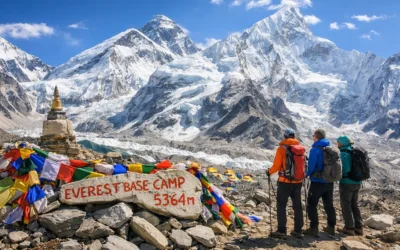
The Sagarmatha National Park Entry Permit is issued by the Department of National Parks and Wildlife Conservation (DNPWC) under the Government of Nepal. It grants legal entry into Sagarmatha National Park, a protected area covering the entire Khumbu region from Monjo through Namche Bazaar, Tengboche, Dingboche, Lobuche, Gorak Shep, and all the way to Everest Base Camp at 5,364 meters.
The park was established in 1976 and designated a UNESCO World Heritage Site in 1979, making it one of the most significant protected areas in the Himalayas. The permit system has been in effect since the late 1970s, and every trekker entering the park must carry this document.
Revenue from this permit directly funds conservation efforts for rare Himalayan wildlife including snow leopards, red pandas, Himalayan tahr, and musk deer. It also supports trail maintenance, waste management programs, park ranger operations, emergency response services, and protection of Sherpa cultural heritage sites throughout the Khumbu valley.
How Much Does It Cost in 2026/27?
| Nationality | Cost |
| Foreigner (Non-SAARC) | NPR 3,000 (~USD 22) |
| SAARC National | NPR 1,500 (~USD 11) |
| Nepali Citizen | NPR 100 (~USD 0.75) |
| Children under 10 | Free (with parent documentation) |
These rates are set by the Nepal Tourism Board and have remained stable for several years. SAARC member countries include India, Bangladesh, Sri Lanka, Pakistan, Bhutan, Maldives, and Afghanistan. All fees are non-refundable.
Where Can You Get This Permit?
Permits can be obtained through two primary channels in 2026/27.
In Kathmandu: Tourist Service Center (Tourist Information Office), Exhibition Road, Bhrikutimandap, Kathmandu, Nepal. Office hours are Sunday through Friday, 9:00 AM to 5:00 PM. Winter hours may be 9:00 AM to 4:00 PM. The office is closed on Saturdays and public holidays, though occasional Saturday morning openings have been reported during peak trekking season.
The office is located at Bhrikutimandap on Exhibition Road in central Kathmandu. You can reach it by taxi, local bus heading to Bhrikutimandap or Exhibition Road, or on foot-approximately 15 minutes walking from Thamel and 10 minutes from Ratna Park.
On the Trail: The Monjo checkpoint serves as the official entry gate to Sagarmatha National Park. You can purchase the permit here if you do not already have one from Kathmandu. However, this option carries risks including cash-only payment requirements, potentially long queues during peak season, and limited office hours.
Where Is This Permit Checked?
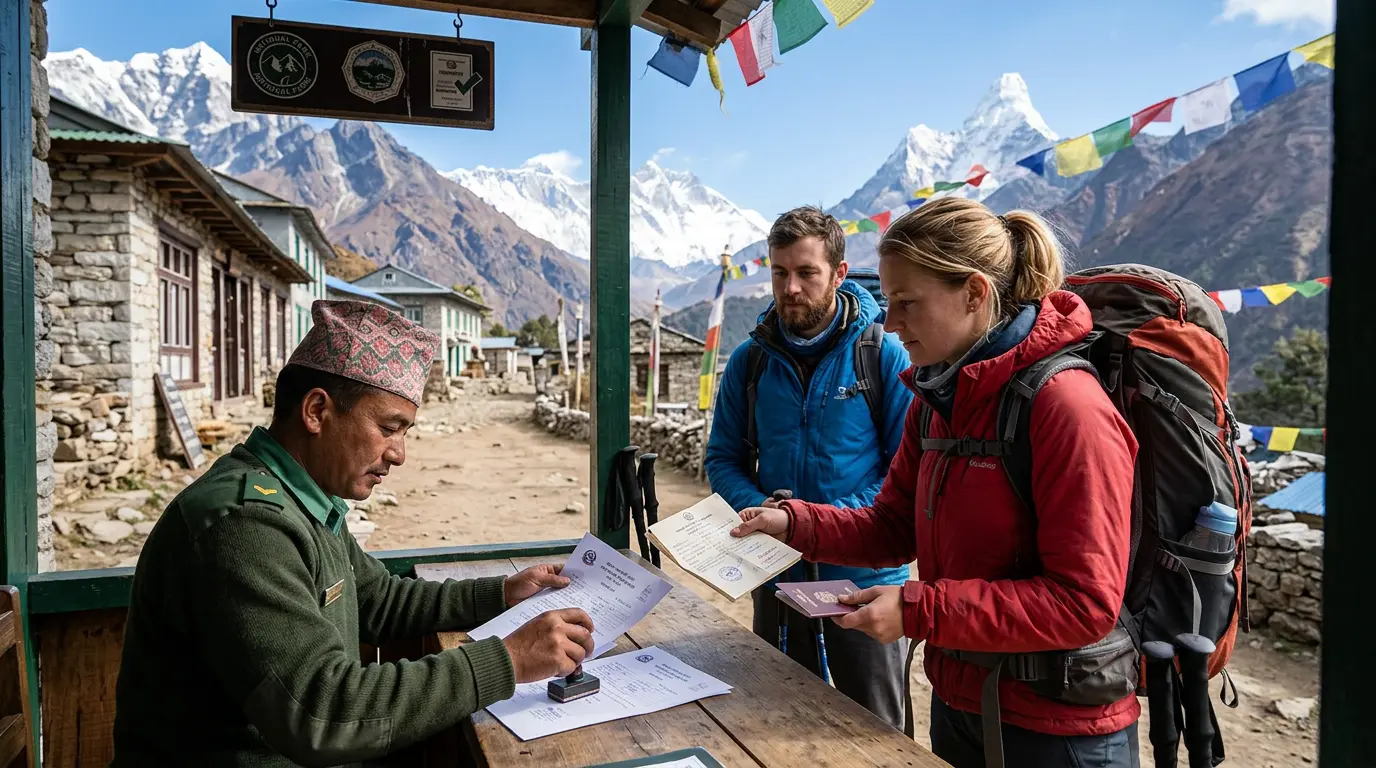
Your Sagarmatha National Park permit will be thoroughly checked at the Monjo Gate, the main entry checkpoint where every single trekker is verified before entering the park. Occasional random checks also occur near Namche Bazaar by park officers conducting trail patrols.
Keep your permit easily accessible throughout your trek. Burying it at the bottom of your backpack wastes time at checkpoints and increases the risk of loss or damage.
Permit 2 – Khumbu Pasang Lhamu Rural Municipality Permit
This local permit is often overlooked during trek planning but is mandatory for all trekkers in 2026/27.
What Is This Permit?
The Khumbu Pasang Lhamu Rural Municipality Permit, commonly called the Trek Card, is a local entry permit issued by the Khumbu Pasang Lhamu Rural Municipality government.
Unlike the national park permit which channels revenue to the central government, this permit’s revenue stays directly within the Khumbu community. It funds essential local infrastructure including trail maintenance and repair, waste management and environmental cleanup programs, school funding and community development projects, and healthcare facilities serving remote Khumbu villages.
This permit was introduced to give the local Sherpa community direct control over a portion of tourism revenue, ensuring that people who live in the shadow of Everest actually benefit from the thousands of trekkers passing through their villages each year.
How Much Does It Cost in 2026/27?
| Nationality | Cost |
| Foreigner (Non-SAARC) | NPR 2,600 (~USD 19) |
| SAARC National | NPR 1,300 (~USD 10) |
| Nepali Citizen | Free |
All fees are non-refundable.
Where Can You Get This Permit?
Through Your Agency in Kathmandu: If you are trekking with a registered agency like Himalaya Hub, they handle this permit as part of your package. This is the most reliable and hassle-free option.
In Lukla: The Khumbu Pasang Lhamu Rural Municipality maintains a local office along the main trekking trail in Lukla bazaar, a short walk from the airport and main guesthouse area. You can purchase the Trek Card here before heading further on the trail. Not sure how to get there first? See our full guide on how to get to Lukla.
At Monjo: The permit can also be arranged at the Monjo checkpoint along with your Sagarmatha National Park permit.
Permit 3 – TIMS Card: Do You Still Need It for EBC in 2026/27?
This is the most confusing aspect of EBC trek planning in 2026/27, with conflicting information across different sources.
What Is TIMS?
TIMS stands for Trekkers’ Information Management System. It is a tracking card originally designed to monitor all trekkers in Nepal’s protected areas for safety purposes, emergency response coordination, and tourism data management.
The Current Status for EBC in 2026/27
For the Everest and Khumbu region specifically, TIMS has been largely replaced by the Khumbu Pasang Lhamu Rural Municipality Permit (Trek Card) for tracking and safety purposes.
Many EBC trekkers in 2026/27 will not need a separate TIMS card because the local Trek Card now fulfills the same function. However, some agencies still process TIMS as a standard part of their trekking package. This is not incorrect-it simply provides redundant documentation.
TIMS remains mandatory for other trekking routes throughout Nepal including the Annapurna region (Circuit, Base Camp, Poon Hill), Langtang region, Ganesh Himal, and all restricted areas such as Upper Mustang, Dolpo, and Manaslu.
TIMS Cost (If Required for Your Route)
| Category | Cost |
| FIT (Free Individual Trekker) – Green Card | NPR 2,000 |
| Group/Organized Trekker – Blue Card | NPR 1,000 |
| SAARC Nationals | NPR 1,000–2,000 |
| Nepali Citizens | Free |
The NPR 1,300 figure appearing in some 2026/27 guides represents an agency-standardized rate. Your actual cost may vary-always confirm with your specific agency.
Where to Get TIMS
TIMS is issued through TAAN (Trekking Agencies’ Association of Nepal), not directly by the Nepal Tourism Board. Primary issuance locations include the TAAN TIMS Counter in Saatghumti, Thamel, Kathmandu (open 7:00 AM to 6:00 PM, with Saturday and holiday hours from 10:00 AM to 1:00 PM), TAAN Secretariat in Maligaun, Kathmandu, and TAAN Pokhara Secretariat.
The Bottom Line for EBC Trekkers
If you are booking through an agency like Himalaya Hub, the agency will confirm whether TIMS is needed for your specific route and dates. If required, they handle the entire process as part of your package.
If you are arranging permits independently, confirm current TIMS requirements directly with the Nepal Tourism Board or TAAN office at the time of your trek, as regulations can change between seasons.
2026/27 Updated Rule – Can You Trek Solo to Everest Base Camp?
This regulation fundamentally changed independent trekking in Nepal and remains strictly enforced in 2026/27.
The Short Answer
No. Solo trekking is banned for foreign nationals in Nepal. This rule has been in effect since April 2023 and continues with strict enforcement throughout 2026 and 2027.
What Exactly Is the Rule?
Since April 2023, Nepal government regulations require that every non-Nepali trekker in national parks, conservation areas, and restricted areas must hire a licensed trekking guide who holds a valid NTB/TAAN license and book through a government-registered trekking agency. This is not optional. This is law.
The rule applies to all popular trekking routes throughout Nepal including Everest Base Camp, Annapurna Circuit and Base Camp, Langtang Valley, Manaslu Circuit, and all restricted areas. Nepali citizens can still trek solo. The ban applies exclusively to foreign nationals.
Why Was This Rule Introduced?
The Nepal government introduced the mandatory guide requirement for three primary reasons based on years of trekking accidents and incidents.
Safety concerns drove much of the decision. Every year, solo trekkers got lost on trails, suffered severe altitude sickness without assistance, or experienced accidents in remote areas with no one to help or coordinate rescue. A licensed guide significantly reduces these risks through trail knowledge, altitude sickness symptom recognition, and emergency evacuation coordination capability.
Security and tracking became critical after several incidents where the government could not locate missing trekkers. With a registered guide, authorities can track which trekkers are on which trails, making emergency coordination faster and more effective during natural disasters, avalanches, or sudden weather changes.
Economic impact and local employment factored into the decision as well. The rule creates formal employment for hundreds of local guides and porters, ensuring tourism revenue reaches the mountain communities rather than being spent entirely outside Nepal before trekkers even arrive.
What Does This Mean for Your Trek?
The nuance here is important-you can still plan independently and control your own trek experience. You choose your own route, daily pace, rest days, acclimatization schedule, and which teahouses to stay in. You choose what you eat and where you sleep. You control your own itinerary and daily decisions. You simply cannot enter trekking zones without a registered guide walking with you for safety and legal compliance.
Think of it as independent but guided trekking. Your guide is there for safety, route navigation, and regulatory compliance, but you remain in control of your trek experience and daily decisions. Most experienced guides understand this dynamic and respect trekker independence while fulfilling their safety role. Before you book, it helps to understand how difficult the Everest Base Camp trek actually is so you can brief your guide on your experience level.
How Much Does a Licensed Guide Cost?
| Service Level | Daily Rate (USD) |
| Guide only – you pay your own food and lodging | USD 25–35/day |
| Guide for popular routes (EBC, Annapurna) | USD 40–50/day |
| Multi-lingual or expedition-level guide | Up to USD 60/day |
For a typical 12 to 15 day EBC trek, expect to pay roughly USD 300 to 600 total for guide services only. If you book with Himalaya Hub, a licensed NTB/TAAN guide is included in your package at no extra cost.
Where to Hire a Licensed Guide
The best and safest option is booking through an NTB-registered trekking agency. Ask explicitly whether the guide is NTB/TAAN licensed and verify the agency’s registration number. Reputable agencies like Himalaya Hub employ only properly licensed guides who have completed official training programs.
Freelance guides are also an option. Many licensed guides market themselves as freelance or independent, which is allowed under current regulations. However, the guide must still operate under a registered agency for permit paperwork and legal compliance. You can find freelance guides through trekking forums, Facebook groups dedicated to Nepal trekking, TripAdvisor guides sections, and word-of-mouth recommendations from other trekkers returning from routes. Always verify their license credentials before committing to any arrangement.
How to Get Your EBC Trek Permits – 3 Options
You have three methods for obtaining permits in 2026/27. Each has distinct advantages and disadvantages based on your budget, experience level, and tolerance for bureaucratic processes.
Option 1 – Get Them Yourself in Kathmandu
This approach saves money but requires time and comfort navigating government offices in a foreign country. Best suited for experienced travelers who have dealt with permit systems before.
Where to Go: Tourist Service Center (Tourist Information Office), Exhibition Road, Bhrikutimandap, Kathmandu, Nepal. Office hours are Sunday through Friday, 9:00 AM to 5:00 PM (winter hours may be 9:00 AM to 4:00 PM). The office is closed on Saturdays and public holidays.
You can reach the office by taxi (10-15 minute ride from Thamel), local bus heading to Bhrikutimandap or Exhibition Road, or on foot-approximately 15 minutes walking from Thamel and 10 minutes from Ratna Park.
What to Bring: Valid passport (original plus 3 photocopies), Nepal tourist visa, 4 passport-size photos with white background, cash in NPR for exact permit fee amounts, and emergency contact details.
The Process: Arrive at the office-aim for 9:00 AM to avoid queues. Fill out permit application forms available at the counter. Submit your passport, photos, and visa copy. Pay the fees in cash (NPR only). Receive your permits.
Processing Time: Same day service-usually 30 minutes to 1 hour depending on queue length.
Payment: Cash in NPR is required. Card payment infrastructure is unreliable-do not count on it working. The office does not accept foreign currency.
Strategy: Visit on a weekday morning. Peak trekking season (March to May and September to November) means significantly longer queues. Monday mornings are often the busiest due to the weekend backlog.
Option 2 – Get Them on the Trail
Possible but not recommended. This option carries multiple risks that can disrupt your trek.
Where You Can Get Permits on Trail:
| Permit | Available on Trail? | Location |
| Sagarmatha National Park Entry Permit | Yes | Monjo checkpoint |
| Khumbu Rural Municipality Permit | Yes | Lukla bazaar / Monjo |
| TIMS Card | No | Kathmandu only |
Why This Is Risky: Cash-only payment is required at all trail offices with no card payment option. Long queues form during peak trekking season-you could wait 1 to 2 hours or more at Monjo during busy periods. Limited office hours mean trail offices may not be open early morning or late evening when you arrive. TIMS is not available on the trail at all-you must obtain it in Kathmandu before flying to Lukla. Every hour spent at a permit office is an hour you could be trekking and acclimatizing. Remote offices sometimes face shortages of forms or supplies during peak season.
When This Makes Sense: This option works only if you already have your TIMS card from Kathmandu, you are carrying sufficient NPR cash for permit fees, you are flexible with your time and schedule, and you are prepared for the possibility of significant delays.
Option 3 – Let Your Trekking Agency Handle Everything
This is the recommended option for most trekkers, especially first-timers or anyone who values time and simplicity.
How It Works: You provide your agency with your passport copy (photo page), Nepal visa copy, 4 passport-size photos, and emergency contact details. The agency processes all three permits on your behalf in Kathmandu. Your permits are ready before you fly to Lukla. You show up and trek.
What You Give the Agency: Passport copy showing photo page and passport number, Nepal visa copy, 4 passport-size photos with white background, and emergency contact details (full name, phone number, relationship).
Extra Charges: This depends on the agency. Some charge a processing fee on top of the actual permit costs. Himalaya Hub handles all permits for every EBC client at no extra cost. Permit fees are included in the package price with no hidden charges or surprise fees. Your permits are processed, verified, and ready before your trek begins.
Documents Required for EBC Trek Permits
Every item on this list is essential. Missing even one document can delay or prevent permit issuance.
| Document | Details |
| Valid Passport | Minimum 6 months validity from your trek start date |
| Nepal Tourist Visa | Obtain at airport on arrival or apply online at evisa.gov.np |
| Passport Size Photos | 4 copies – white background, recent photo |
| Passport Photocopies | 3 copies – store in separate bags |
| Travel Insurance Copy | Must explicitly cover altitude up to 6,000 meters and helicopter evacuation |
| Agency Booking Confirmation | If trekking through a registered agency |
| Emergency Contact Details | Full name, phone number, relationship to you |
| Cash in NPR | For permit fees if obtaining permits yourself |
Critical Advice: Keep original documents and photocopies in separate bags. If one bag is lost, stolen, or damaged by weather, you still have backup documentation. Store permits and important documents in a waterproof pouch or ziplock bag. Rain, snow, river crossings, and high humidity are real risks on the EBC trail that can destroy paper documents. Take clear photos of all documents on your phone as digital backup. Upload them to cloud storage (Google Drive, Dropbox) so you can access them even if your phone is lost.
Nepal Visa – How to Get It
You must have a valid Nepal tourist visa before you can apply for any trekking permits. Here is the complete process for 2026/27.
Visa Types and Cost
| Duration | Cost | Best For |
| 15 days | USD 30 | Short treks, quick visits |
| 30 days | USD 50 | Standard EBC trek (most common choice) |
| 90 days (multiple entry) | USD 125 | Extended travel, multiple treks |
These fees have remained unchanged for several years and are set by the Nepal Department of Immigration. Children under 10 years enter Nepal free with parent documentation.
How to Get Your Visa
Visa on Arrival (Most Common Method): Visa on arrival is available at Tribhuvan International Airport in Kathmandu and at all major land border crossings including Kakarbhitta, Birgunj, Sunauli, and Rasuwagadhi. The process is straightforward. Fill out the arrival form, submit your passport and one passport-size photo, pay the visa fee, and receive your visa stamp. Carry USD cash for payment. Card machines at immigration counters frequently fail. Expect queues during peak trekking season-budget 30 to 60 minutes for the entire visa process.
Online Pre-Application (Highly Recommended): You can apply for your Nepal visa online at evisa.gov.np before arrival. After completing the form and uploading your photo, you will receive a confirmation that helps you skip the form-filling queue at the airport. This is especially useful during peak trekking seasons when arrival lines are longer.
Indian Nationals – No Visa Required: Indian citizens do not need a visa to enter Nepal under the bilateral travel arrangement. A valid passport is the most reliable document and is required for air travel. Always carry original documents, as photocopies are not accepted, and proper ID is still needed for trekking permit applications in Kathmandu.
EBC Permit Cost Breakdown by Nationality
Calculate your exact permit budget based on your nationality using these official 2026/27 rates.
Foreigners (Non-SAARC)
| Permit | Cost (NPR) | Cost (USD approx) |
| Sagarmatha National Park Entry Permit | 3,000 | 22 |
| Khumbu Pasang Lhamu Rural Municipality Permit | 2,600 | 19 |
| TIMS Card | 1,300 | 10 |
| Total | NPR 10,800 | ~USD 80 |
This applies to citizens of the United States, United Kingdom, all European Union countries, Australia, Canada, China, Japan, Korea, and all other non-SAARC nations. For a full picture of what you’ll spend overall, see our detailed guide on the full cost of the Everest Base Camp trek.
Indian Nationals / SAARC Countries
| Permit | Cost (NPR) | Cost (USD approx) |
| Sagarmatha National Park Entry Permit | 1,500 | 11 |
| Khumbu Pasang Lhamu Rural Municipality Permit | 1,300 | 10 |
| TIMS Card | 1,300 | 10 |
| Total | NPR 5,550 | ~USD 41 |
SAARC member countries include India, Bangladesh, Sri Lanka, Pakistan, Bhutan, Maldives, and Afghanistan. Indian nationals benefit additionally from visa exemption, saving the USD 50 cost of a 30-day Nepal tourist visa.
Nepali Citizens
| Permit | Cost (NPR) |
| Sagarmatha National Park Entry Permit | 100 |
| Khumbu Pasang Lhamu Rural Municipality Permit | Free |
| TIMS Card | Free |
| Total | NPR 100 |
Nepali citizens are not completely exempt from permit fees. Sagarmatha National Park charges NPR 100 for Nepali visitors to support conservation efforts. However, the Khumbu Rural Municipality permit and TIMS card are free for Nepali citizens. A valid citizenship card (Nagarikta) is required for permit application.
Children
Children under 10 years old can enter Sagarmatha National Park free with parent documentation, such as a passport copy and birth certificate. Children aged 10 and above pay the full permit fee based on nationality. There is no separate child rate for the Khumbu Rural Municipality permit or TIMS card.
Does the Permit Cost Change by Season?
No. Everest Base Camp permit fees stay the same throughout the year, whether you trek in peak season or off-season. There are no seasonal discounts on permits. However, overall trek package prices may change by season because flights, lodges, and guide costs are usually higher during busy months.
Where Are Permits Checked on the Trail?
Understanding checkpoint locations helps you stay prepared and avoid surprises during your trek. If you are still planning your overall route, our Everest Base Camp route guide covers the full trail in detail.
Checkpoint Locations
| Checkpoint | Location on Trail | What Is Checked | Check Intensity |
| Lukla | Trek starting point | Initial document verification | Light check |
| Monjo | Sagarmatha National Park main gate | Sagarmatha NP permit, Khumbu Rural Municipality permit | Thorough – every trekker checked |
| Namche Bazaar area | Along the trail | All permits, guide license | Random checks |
What Happens at a Checkpoint?
At each checkpoint, officers ask to see your permits, passport, and your guide’s license. They record your details, check that your documents are valid and match your identity, and then allow you to continue. The process usually takes 5 to 10 minutes, though it can take longer during peak season due to queues.
Monjo Checkpoint – The Main Gate
Monjo is the main entry checkpoint to Sagarmatha National Park, and every trekker is checked here without exception. It is open every day, but it is best to arrive during daylight hours. Officers verify your permits, passport, and guide license, so this is where most document problems are discovered. If your paperwork is missing or invalid, you will not be allowed to continue into the park.
What Happens If You Lose Your Permit on the Trail?
If you lose your permit on the trail, your trek may be stopped at the next checkpoint because officers can refuse entry without valid documents. You may need to return to Lukla or Kathmandu to get a replacement, and in most cases you will have to pay the full fee again. This can cost you valuable trekking days and disrupt your itinerary and acclimatization plan.
This is exactly why we strongly recommend: keep photocopies of all permits in a separate bag from the originals, store them in a waterproof pouch, and save clear photos on your phone as a digital backup. If you are trekking with an agency, your guide will usually carry copies as well.
Permit Validity and Renewal
Understanding permit validity periods and renewal options prevents complications if your trek runs longer than planned.
How Long Are the Permits Valid?
| Permit | Validity Period | Entry Type |
| Sagarmatha National Park Entry Permit | 15 to 30 days from first park entry | Single entry |
| Khumbu Rural Municipality Permit | Duration of your trek | Single entry |
| TIMS Card | Duration of your trek | Single entry |
Important Details: The Sagarmatha National Park permit is single entry only. Once you exit the park boundary (for example, back past Monjo toward Lukla), the permit is considered used. If you want to re-enter the park, you need a brand new permit at full cost.
Validity starts when you first enter the park at the Monjo checkpoint-not from the date the permit was issued in Kathmandu. If you get your permit on March 1st but do not reach Monjo until March 5th, your 15-day or 30-day validity begins on March 5th.
The standard EBC trek itinerary takes 12 to 15 days round trip, which falls comfortably within the 15 to 30 day validity window. To understand how long the full walk to Everest Base Camp takes, see our complete guide.
Can You Extend Your Permit If the Trek Gets Delayed?
Yes, permit extensions are possible under certain circumstances, but they are not easy to arrange while you are already on the trail.
Where to Extend: Permit extensions are usually handled at official government offices in Kathmandu, mainly the Nepal Tourism Board, DNPWC counters, or the Tourist Service Center at Bhrikutimandap. On-trail extensions in the Khumbu region are not routine.
Extension Cost: Permit extension usually costs around NPR 1,000 to 2,000 per person, though the exact fee is not always standardized and may vary by office or agency. You must apply before your current permit expires. If the permit has already expired, you may need to pay the full permit fee again.
Practical Advice for Validity Planning: Plan your itinerary to finish within the 15 to 30 day validity period and keep a few buffer days for weather or acclimatization delays. If your trek may take longer due to routes like Gokyo, Cho La Pass, or the Three Passes, ask your agency to arrange a longer-validity permit in advance. If you book with Himalaya Hub, share your full itinerary early so the team can arrange the correct permit duration for your trek.
What Happens If You Trek Without a Permit?
Do not risk this. Enforcement is real, consequences are serious, and the cost of proper permits is minimal compared to the penalties.
| Consequence | What Happens |
| Immediate trek stoppage | Checkpoint officers will not allow you to pass under any circumstances |
| Sent back | You will be turned around at Monjo or the nearest checkpoint and required to return to Lukla |
| Fines | Progressive daily fines apply-amounts vary but expect NPR 1,000 to 5,000 or more |
| Guide penalized | Guide’s license can be suspended or permanently revoked |
| Legal action | Possible in repeat violations or severe cases-including potential detention and deportation |
| Blacklisting | May negatively affect your future Nepal visa applications |
The Reality of Enforcement
Officers at the Monjo checkpoint check every trekker entering Sagarmatha National Park, and there is no bypass route. Your guide’s license is also verified at major checkpoints. The total permit cost for a foreign trekker is NPR 10,800-a small amount compared to the risk of fines, trek cancellation, legal trouble, or future travel restrictions in Nepal.
Travel Insurance for EBC Trek – What You Need to Know
Travel insurance is not a permit, but it is just as critical for a safe Everest Base Camp trek.
Is Travel Insurance Legally Mandatory?
Nepal law does not require travel insurance for trekking. However, virtually all reputable agencies including Himalaya Hub require proof of adequate coverage before confirming bookings. Without insurance, you are personally liable for all emergency costs. A single helicopter evacuation from Everest Base Camp to Kathmandu costs USD 5,000 to 10,000 depending on weather and location. Medical treatment adds thousands more.
What Must Your Insurance Cover?
Standard travel insurance policies routinely exclude coverage for altitudes above 4,000 meters. Everest Base Camp sits at 5,364 meters. Kala Patthar, which most trekkers climb for the famous Everest view, reaches 5,545 meters. If your policy does not explicitly state coverage for altitudes up to at least 6,000 meters, you are uninsured for the most dangerous portions of your trek.
| Coverage Type | Minimum Recommended Amount |
| Medical emergencies | USD 500,000 to 1,000,000 |
| Maximum altitude coverage | Must explicitly state up to 6,000 meters |
| Helicopter evacuation | Must be explicitly included |
| Trip cancellation/interruption | Recommended |
| Baggage and trekking gear loss | Recommended |
| Emergency repatriation to home country | Recommended |
Why Altitude Coverage Matters for EBC
Everest Base Camp sits at 5,364 meters where oxygen levels are roughly 50 percent of sea level. Medical studies show that 40 to 50 percent of trekkers experience Acute Mountain Sickness (AMS) symptoms during the trek. High Altitude Pulmonary Edema (HAPE) and High Altitude Cerebral Edema (HACE) are life-threatening conditions that can become fatal within hours without immediate descent and treatment. The nearest hospital is in Kathmandu-multiple days away on foot.
Helicopter evacuation is often the only option for serious altitude emergencies. Average cost ranges from USD 5,000 to 8,000, sometimes exceeding USD 10,000 in difficult weather conditions. If you are uninsured, your guide must pay evacuation costs upfront before the helicopter will fly.
How Much Does a Proper Policy Cost?
Comprehensive travel insurance covering high-altitude trekking to 6,000 meters with helicopter evacuation typically costs approximately USD 50 to 250 for a 2 to 3 week trek. Typical policy excess or deductible ranges from USD 750 to 1,500. This represents a tiny fraction of what you would pay out of pocket for an emergency evacuation.
What Will Your Agency Ask?
Your trekking agency will request your complete insurance policy as a PDF or printed copy to verify actual coverage details. The policy must explicitly state coverage for altitudes up to 6,000 meters and include helicopter evacuation as a covered medical benefit. Vague terms like “emergency medical transportation” may not cover helicopter rescue from high-altitude locations.
Himalaya Hub verifies insurance for every client before departure. If your policy does not meet altitude or evacuation requirements, the team can recommend suitable providers for Himalayan trekking coverage.
7 Pro Tips to Make Your Permit Process Hassle-Free
1. Get All Permits in Kathmandu Before Your Trek Trail permit offices have unpredictable hours, long queues during peak season, and cash-only payment. Getting everything processed in Kathmandu before flying to Lukla eliminates these risks entirely.
2. Carry Sufficient NPR Cash Permit offices and trail checkpoints do not accept cards or foreign currency. Exchange money to NPR in Kathmandu before heading to permit offices. ATMs in Thamel sometimes run out of cash during peak season.
3. Bring 4 to 5 Extra Passport Photos You need photos for every permit application. Trail checkpoints occasionally request additional photos. Get them in Thamel for NPR 200 to 300 for four photos-remote villages may have no photo services.
4. Keep Photocopies in Separate Bags Make 3 copies of your passport, visa, permits, and insurance. Keep one in your daypack, one in your main bag, and give one to your guide. If one bag is lost, you still have backup documentation.
5. Use a Waterproof Pouch The EBC trail has river crossings, rain, snow, and high humidity. Paper permits can be destroyed quickly. A ziplock bag or waterproof pouch protects everything important.
6. Visit Permit Offices Early Morning Offices open at 9:00 AM. Arrive by 9:00 to 9:30 AM for short queues. By 11:00 AM during peak season, expect over an hour wait. Monday mornings are busiest.
7. Let Your Agency Handle Everything When you book with Himalaya Hub, every permit is processed for you at no extra cost. You skip government offices, application forms, and queues-just arrive and start trekking.
Conclusion
The Everest Base Camp permit process in 2026/27 is straightforward once you know what is required. Foreigners pay NPR 10,800, SAARC nationals NPR 5,550, and Nepali citizens NPR 200. Once your permits are sorted, you can focus on the trek itself-including where Everest Base Camp is located and how difficult the route feels for most trekkers. If you are planning the full trip, you can also check the Everest Base Camp trek itinerary and the full cost of the Everest Base Camp trek.
Frequently Asked Questions
What permits are required for Everest Base Camp Trek in 2026/27?
You need three permits: the Sagarmatha National Park Entry Permit, the Khumbu Pasang Lhamu Rural Municipality Permit, and the TIMS Card. Foreign trekkers also need to trek with a licensed guide through a registered agency because solo trekking is banned.
How much do all EBC trek permits cost in total?
Foreign trekkers pay NPR 10,800, SAARC nationals pay NPR 5,550, and Nepali citizens pay NPR 200 in total.
Can I get Everest Base Camp Trek permits online in 2026/27?
No, there is no fully online system for EBC trek permits yet. You must get them in Kathmandu, at certain trail checkpoints, or through a registered trekking agency.
Are EBC permits available at Lukla or on the trail?
Partially. The Sagarmatha National Park permit and Khumbu Rural Municipality permit can be arranged on the trail, but TIMS is handled in Kathmandu. Getting permits in Kathmandu is the safer option.
How much do EBC permits cost for Indian nationals?
Indian nationals pay SAARC rates, totaling NPR 5,550 for all permits. They also do not need a Nepal visa, reducing overall travel cost.
Do Nepali citizens need permits for EBC trek?
Yes. Nepali citizens still need permits, but the fees are much lower. They pay NPR 100 for Sagarmatha National Park, while the Khumbu permit and TIMS are free.
Does the EBC permit fee change by season?
No, official permit fees stay the same throughout the year.
How long is the Everest Base Camp Trek permit valid?
The Sagarmatha National Park permit is generally valid for 15 to 30 days from first entry and works as a single-entry permit. The Khumbu permit and TIMS are valid for the duration of your trek.
Can I extend or renew my permit during the trek?
Yes, but it is not easy on the trail. Extensions are usually processed in Kathmandu, costing around NPR 1,000 to 2,000 per person.
What happens if I trek without a permit in Nepal?
You will be stopped at the checkpoint and not allowed to continue. You may also face fines, extra charges, legal issues, or future travel restrictions in Nepal.
Can I trek to Everest Base Camp solo in 2026/27?
No. Foreign nationals cannot legally trek solo. You must hire a licensed guide through a registered trekking agency.
Is travel insurance mandatory for EBC trek?
It is not legally required by Nepal law, but most reputable agencies require it. Your policy should cover high-altitude trekking up to 6,000 meters and helicopter evacuation.
Do I need a visa for Everest Base Camp Trek?
Yes, all foreign nationals except Indian citizens need a Nepal tourist visa. A 30-day visa costs USD 50 and can be obtained on arrival or through online pre-application.
Is a passport required for Everest Base Camp Trek?
Yes, a valid passport is required for permit applications and checkpoint verification. It should have at least 6 months validity from your trek date.
Is helicopter evacuation insurance needed for EBC trek?
Yes, it is strongly recommended. Helicopter evacuation from the EBC trail can cost USD 5,000 to 10,000, and proper insurance is the only practical way to cover that risk.