Yes. You can do the Everest Base Camp trek on a budget. The realistic floor for a safe, licensed, guided 14-day EBC trek in 2026 is USD 1,000 to 1,200 all-in from Kathmandu. Not 800. Not 600. Those figures exist in some articles, but they skip a guide, cut corners on safety, and underestimate the permit costs, the Lukla flights, the gear, and the tips. This guide tells you what budget actually means on the EBC trail and 15 specific ways to reduce what you spend without reducing your safety.
Most EBC cost guides give you a range of 800 to 5,000 dollars and call it done. That range is technically accurate and completely useless for planning. This guide collapses it into something you can actually use: verified 2026 figures, four complete budget scenarios, and an honest answer to every question about where you can cut and where you absolutely cannot.
For duration planning that affects your overall budget, how long is the Everest Base Camp trek gives the standard itinerary options.
Can You Do Everest Base Camp on a Budget? The Short Answer
Yes. A budget Everest Base Camp trek in 2026 costs USD 1,000 to 1,200 all-in from Kathmandu for a 14-day guided trek booked with a local Nepali agency. This includes permits, Lukla flights booked in advance for shoulder season, a licensed guide via group departure, basic teahouse accommodation, local food, and essential travel insurance. Shoestring approaches without a guide can bring this to USD 800 to 950, but this is legally problematic and not recommended.
| Trek Type | Total Cost (USD) | Guide | Accommodation | Food | Notes |
| Shoestring no guide | 800–950 | No | Basic teahouse | Dal Bhat only | Not recommended legally grey |
| Budget guided | 1,000–1,200 | Yes | Basic teahouse | Local food | Recommended minimum |
| Standard guided | 1,400–2,000 | Yes | Comfortable | Mixed | Most popular option |
| Premium guided | 2,500–3,500 | Yes senior | Better lodges | Full choice | Includes helicopter return option |
| Luxury | 3,500–6,500 and above | Yes private | Premium | All inclusive | Full private experience |
Everest Base Camp Permits 2026 – What You Must Pay
Everest Base Camp Permits are unavoidable and non-negotiable. Understanding exactly what is required and what is not saves both money and confusion at checkpoints.
The Two Mandatory Permits for EBC in 2026
Sagarmatha National Park Entry Permit
Cost for foreign nationals: NPR 3,000, approximately USD 22. SAARC nationals pay NPR 1,500. Children under 10 enter free. This permit can be obtained at the Nepal Tourism Board office at Bhrikutimandap in Kathmandu or at the Monjo entry gate on the trail. Getting it in Kathmandu before your Lukla flight avoids queues at Monjo and is the recommended approach.
Khumbu Pasang Lhamu Rural Municipality Permit (Trek Card)
Cost: NPR 2,000 to 3,000, approximately USD 15 to 22. This digital card system was introduced in 2022. It cannot be obtained in Kathmandu; it must be purchased at Lukla or the Monjo checkpoint on the trail. Pay in Nepali Rupees; permit offices do not accept foreign currency.
2026 TIMS Update – Important Correction
The TIMS card is no longer required for the Everest and Khumbu region. It was replaced by the Khumbu Pasang Lhamu Rural Municipality Permit in 2022. Many older blog posts and some competitor articles still list TIMS as required for EBC; this is incorrect. TIMS remains required in Annapurna, Langtang, and Manaslu regions, but not for the EBC route.
Total permit cost for foreign trekkers: approximately NPR 5,000 to 6,000, or USD 37 to 44. This is one of the lowest line items in the entire EBC budget.
Lukla Flights – The Biggest Budget Variable
The Kathmandu to Lukla flight is the single biggest variable in the EBC budget and the cost most trekkers either underestimate or do not plan far enough in advance.
2026 Lukla Flight Prices
One-way Kathmandu to Lukla for foreign nationals costs approximately USD 254 as of 2026 an increase of 10 to 20 percent from 2025 figures, driven by aviation fuel price rises. Round-trip cost per person is USD 360 to 480 depending on season. Peak season months April and October are at the higher end of this range. Booking two to three months in advance is essential for spring and autumn departures.
The Jiri Route – Skip the Lukla Flight Entirely
The most significant single saving available to budget EBC trekkers is starting the trek from Jiri or Salleri rather than flying to Lukla. This eliminates the USD 360 to 480 round-trip flight cost per person.
The trade-off is time: the Jiri route adds three to four extra trekking days. You will also need a Gaurishankar Conservation Area Permit (approximately NPR 2,000 or more) for the Jiri section. After accounting for additional accommodation and food costs over the extra days, net savings compared to flying are approximately USD 150 to 250. For trekkers with flexible schedules, the Jiri route is the original historic EBC approach the route Sir Edmund Hillary used and is a meaningfully richer trekking experience than beginning at Lukla.
For the complete Jiri route itinerary and logistics, the Jiri to Everest Base Camp Trek guide covers the classic approach in full detail.
Other Flight Saving Tips
Shoulder season months March and November offer Lukla flight prices USD 50 to 100 lower than peak October and April departures. For the full seasonal cost and weather picture, best time to trek Everest Base Camp gives month-by-month guidance.
Guide and Porter Costs – What Is Mandatory and What Is Optional
The Guide Requirement
Since April 2023, all foreign trekkers in Nepal’s National Parks must hire a licensed guide. The EBC route passes through Sagarmatha National Park; the regulation applies in full. Trekking without a licensed guide is illegal, can result in a fine of up to NPR 12,000, and voids travel insurance coverage if you need evacuation while non-compliant.
Licensed guide cost: USD 25 to 35 per day. In addition, trekkers are expected to cover the guide’s food and accommodation on the trail approximately USD 10 to 15 per day extra. For a 14-day trek, the total guide cost including their food and lodging ranges from USD 490 to 700.
The most effective budget reduction available: join a group departure and split the guide cost among four to six trekkers. A guide cost that totals USD 500 for a solo trekker becomes USD 125 per person in a group of four. This single change reduces the overall trek budget by USD 300 to 400 per person compared to hiring a private guide.
Porter – Optional but Recommended
A porter is not legally required but is strongly recommended for most trekkers on the EBC route. Porter cost is USD 20 to 30 per day. One porter typically carries bags for two trekkers, splitting this cost between two people reduces the per-person expense to USD 140 to 210 for a 14-day trek.
The most cost-effective approach: carry your own 8 to 10 kg daypack for the day’s walking and hire one porter between two trekkers to handle the heavier gear bag. This maintains reasonable pack weight on the ascent days while keeping porter costs at roughly USD 10 to 15 per person per day.
Teahouse Accommodation and Food – Budget Reality Day by Day
Teahouse Accommodation
Teahouse prices on the EBC route increase with altitude, a consistent pattern across all Nepal’s high-altitude trails.
Lower elevations (Lukla to Namche): USD 5 to 10 per night. Mid-elevations (Namche to Dingboche): USD 10 to 20 per night. Higher elevations (Lobuche, Gorak Shep): USD 15 to 40 per night.
An important budget principle at all elevations: teahouses often offer a lower room rate or free accommodation in exchange for taking all meals at their establishment. Committing to eat at your teahouse rather than wandering to another lodge for a cheaper menu frequently reduces the accommodation cost to zero or nominal amounts. This is standard practice on the trail and worth negotiating when you arrive.
Food and Drink Budget
| Item | Lower Elevations | Higher Elevations |
| Dal Bhat | USD 5–7 (often unlimited refills) | USD 8–12 |
| Pasta or noodles | USD 5–8 | USD 8–14 |
| Eggs and breakfast | USD 3–5 | USD 5–9 |
| Tea or coffee | USD 1–2 | USD 2–4 |
| Bottled water (1 litre) | USD 1–2 | USD 3–5 |
| Western meals | USD 10–15 | USD 15–25 |
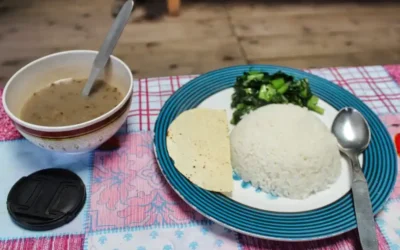
Three food rules for budget trekkers: Order Dal Bhat wherever possible it is the cheapest option, typically comes with unlimited refills of rice, lentil soup, and vegetables, and is nutritionally well-suited to the physical demands of the trek. Carry water purification tablets from Kathmandu (USD 5 to 10 for the entire trek) rather than purchasing bottled water at USD 3 to 5 per litre at altitude. Buy trail snacks, chocolate, energy bars, nuts in Thamel before departure. The same items cost three to four times more at altitude.
Average daily food budget eating local: USD 20 to 25. Average daily food budget with mixed Western and local meals: USD 30 to 45.
Daily Extras That Add Up
| Item | Cost |
| Hot shower (bucket) | USD 5–10 at altitude |
| Device charging (per session) | USD 1–3 |
| WiFi (per session) | USD 3–5 |
| Laundry (per wash) | USD 5–10 |
| Snacks purchased on trail | USD 2–5 each |
A power bank purchased before departure eliminates most charging costs. A local Ncell or NTC SIM card bought in Kathmandu for under USD 5 provides data connectivity in lower and mid-altitude sections at a fraction of teahouse WiFi pricing.
Hidden Costs Most EBC Budget Guides Miss
This is what separates a realistic EBC budget from one that leaves trekkers short of cash at altitude.
Nepal Tourist Visa
15-day visa: USD 30 on arrival at Tribhuvan International Airport. 30-day visa: USD 50. For a 14-day EBC trek plus Kathmandu days before and after, the 30-day visa is the practical choice budget USD 50.
Travel Insurance – Cannot Be Skipped
Travel insurance must explicitly cover high-altitude trekking above 5,500 metres (Kala Patthar reaches 5,545m) and emergency helicopter evacuation from Nepal. Budget options for the trek duration cost approximately USD 50 to 150. Without adequate coverage, a helicopter evacuation from the Khumbu region costs USD 3,000 to 10,000 or more out of pocket.
Read the policy before purchasing. Confirm the altitude limit and helicopter rescue coverage in the policy wording do not assume coverage exists based on the product name. For guidance on what to look for, Everest Base Camp insurance guide covers the policy requirements specific to EBC altitude.
Gear Rent in Kathmandu, Do Not Buy
A sleeping bag rated to -15°C and a down jacket are the two items most trekkers either buy unnecessarily or bring from home at significant expense. Both are available for rental in Thamel, Kathmandu.
Sleeping bag rental: USD 1 to 2 per day. Down jacket rental: USD 1 to 2 per day. Total rental cost for both items over 14 days: approximately USD 30 to 60. Purchasing equivalent quality items: USD 300 to 500.
The exception: trekking boots. Comfort and fit matter too much for footwear to be rented. Buy boots that fit properly and break them in before departure. The Everest Base Camp Trek Packing Guide gives the complete gear list with clear guidance on what is worth renting versus what should come from home.
Tips – Budget From the Start
Tips are a cultural expectation for guides and porters in Nepal, not an optional extra. For a 14-day trek, appropriate tipping is USD 100 to 150 for the guide and USD 50 to 100 for the porter a total of USD 150 to 250. Budget for this from the beginning rather than discovering it at the end.
Kathmandu Days
Most trekkers spend two to three nights in Kathmandu before the trek and one to two nights after. Budget guesthouses in Thamel cost USD 10 to 25 per night. Meals in Kathmandu run USD 5 to 15 per day. Total Kathmandu budget for four to five nights: USD 60 to 200 depending on comfort level.
Cash Logistics
There are no ATMs between Namche Bazaar and base camp. Withdraw sufficient cash in Kathmandu or Namche before ascending. Nepal ATM fees run USD 5 to 8 per withdrawal; multiple small withdrawals at different stops cost significantly more than one larger withdrawal at Namche. Withdraw enough Nepali Rupees at Namche to cover the full remainder of the trek.
Altitude Medication
Diamox (acetazolamide) is not mandatory but is widely used for AMS prevention on the EBC route. A full course requires a prescription to get this from your doctor before departure. Available at Kathmandu pharmacies for USD 20 to 50, significantly cheaper than in Western countries.
Complete Budget Scenarios – What Four Types of Trekkers Actually Spend
Scenario 1 – The Budget Trekker: USD 1,000 to 1,200
Books with a local Kathmandu agency on a group departure of four to six people. Shares guide cost across the group. Share one porter between two trekkers. Books Lukla flights in shoulder season (March or November) two to three months in advance. Eats Dal Bhat daily. Carries water purification tablets and a power bank. Rents sleeping bag and down jacket in Thamel.
| Item | Cost (USD) |
| Permits (National Park plus Trek Card) | 44 |
| Lukla round-trip flights (shoulder season) | 360 |
| Guide share one quarter of USD 500 total | 125 |
| Porter share one half of USD 350 total | 175 |
| Accommodation (14 nights at USD 10 average) | 140 |
| Food (14 days at USD 22 per day) | 308 |
| Travel insurance | 75 |
| Gear rental (sleeping bag plus down jacket) | 40 |
| Tips for guide and porter | 150 |
| Nepal tourist visa (30 days) | 50 |
| Kathmandu (4 nights at USD 15 per night, meals USD 8 per day) | 92 |
| Miscellaneous (charging, WiFi, snacks, extras) | 80 |
| Total | Approximately USD 1,069 |
Scenario 2 – The Standard Trekker: USD 1,400 to 2,000
Books a standard guided package with a small group. Private porter included. Mix of local and Western food. Comfortable teahouses throughout. Peak season Lukla flights. More flexibility on extras and charging. This is the most common spending level for first-time EBC trekkers who plan carefully but do not cut corners.
Scenario 3 – The Jiri Budget Trekker: USD 800 to 1,050
Skips the Lukla flights entirely by taking a bus or jeep to Jiri and trekking from there. Adds three to four extra days of walking. Needs the Gaurishankar Conservation Area Permit (approximately NPR 2,000 additional). Licensed guide still required. Total savings versus flying: USD 360 to 480 in flights, offset by three to four additional days of accommodation and food net saving approximately USD 150 to 250. This is the original historic EBC route and a genuinely rewarding approach for trekkers with time.
Scenario 4 – The Standard First-Timer Reality: USD 1,400 to 1,800
Most first-time EBC trekkers who plan realistically end up spending USD 1,400 to 1,800 all-in from Kathmandu. This is not a luxury budget, it is a well-planned, comfortable, stress-free standard that includes all mandatory costs plus reasonable comfort on the trail. Trekkers who budget for USD 1,000 and do not follow the specific money-saving strategies in the next section frequently overspend into this range anyway.
For structured group departure packages that deliver guided EBC treks at budget-friendly price points, HimalayaHub’s Everest Base Camp Trek packages offer tiered options from group budget to private premium, with all permits and guide costs included.
15 Money-Saving Tips for the Everest Base Camp Trek
1. Book with a local Nepali agency instead of an international operator. Local agencies charge 30 to 50 percent less for the same trek quality. The guide, the route, and the teahouses are identical the difference is margin.
2. Join a group departure. Splitting guide and porter costs among four to six trekkers is the single most impactful budget decision. Per-person savings versus a private guide: USD 300 to 400.
3. Trek in shoulder season. March and November Lukla flights are USD 50 to 100 cheaper than peak October and April departures. Teahouse pricing is also slightly lower outside peak months.
4. Book Lukla flights two to three months early. Last-minute prices spike significantly in peak season. Early booking at shoulder-season rates is one of the most reliable ways to lock in the lower end of the flight cost range.
5. Consider the Jiri route. Eliminating both Lukla flights saves USD 360 to 480 per person. After accounting for extra food and accommodation days, net savings are USD 150 to 250. The route itself is a richer trekking experience than the Lukla start.
6. Rent gear in Thamel rather than buying. Sleeping bag plus down jacket for 14 days costs USD 30 to 60 rented versus USD 300 to 500 purchased. For one trek, renting is always the budget choice for these two items specifically.
7. Get a local SIM card in Kathmandu. An Ncell or NTC SIM with data costs less than USD 5 and covers connectivity in lower and mid-altitude sections far more cheaply than teahouse WiFi at USD 3 to 5 per session.
8. Carry water purification tablets. USD 5 to 10 for the entire trek versus USD 3 to 5 per litre for bottled water at altitude. The savings over 14 days is USD 30 to 60 minimum.
9. Order Dal Bhat at every possible meal. Dal Bhat costs USD 5 to 7 in the lower sections and is typically served with unlimited refills. Over 14 days, choosing Dal Bhat over pasta or noodle dishes saves USD 112 to 210 in food costs alone.
10. Buy trail snacks in Thamel before you leave Kathmandu. Chocolate bars, energy gels, nuts, and dried fruit cost three to four times more at altitude. Stock up in Kathmandu at normal market prices.
11. Carry a high-capacity power bank. Device charging at teahouses costs USD 1 to 3 per session. A power bank purchased before departure eliminates this cost entirely across 14 days of trail.
12. Commit to eating at your teahouse. Eating all meals at the lodge where you sleep frequently unlocks a lower room rate or free accommodation. Wandering to another lodge for a cheaper dish costs more in accommodation than it saves in food.
13. Get your National Park permit in Kathmandu, not at Monjo. Same price, significantly faster process. The Monjo checkpoint queue in peak season adds unnecessary time to Day 2 of the trek.
14. Arrange travel insurance before arriving in Nepal. Insurance purchased in your home country or online before departure is significantly cheaper than any emergency coverage arranged after arrival.
15. Make one large ATM withdrawal at Namche. Multiple small withdrawals at different stops generate multiple USD 5 to 8 ATM fees. Namche Bazaar has the last reliable ATMs before high altitude withdraws enough to cover the full remainder of the trek in one transaction.
For training guidance that reduces the physical stress of the trek and therefore the likelihood of needing expensive emergency services how to train for Everest Base Camp gives a structured preparation programme.
Budget Lines You Should Never Cut
Knowing where to save is only half the picture. Knowing where not to cut is equally important and this section is what separates honest budget guides from ones that get trekkers into trouble.
The Licensed Guide
Guide cost for a 14-day trek: USD 490 to 700 total. This is not optional, not negotiable, and not a cost that can be recovered from if you get caught without one. Trekking without a licensed guide in Sagarmatha National Park is illegal under the April 2023 regulation. The fine is up to NPR 12,000. Your travel insurance is voided. Your emergency evacuation coverage disappears precisely when you might need it most.
Saving money on the guide is done by joining a group not by skipping the guide. Those are categorically different decisions.
Acclimatisation Days
Never skip a scheduled acclimatisation day to save the cost of one teahouse night. Acclimatisation days at Namche Bazaar and Dingboche are built into the itinerary because they are physiologically necessary, not because agencies want to sell more nights. Skipping them to save USD 10 to 20 in accommodation is the most expensive budget decision a trekker can make the cost of a helicopter evacuation for AMS that proper acclimatisation would have prevented is USD 3,000 to 10,000 or more.
Travel Insurance
USD 50 to 150 for the trek is the cheapest line item in the entire EBC budget relative to what it protects against. Without it, a single helicopter evacuation costs more than the entire trek. Read the policy, confirm the altitude limit covers 5,545m, and confirm helicopter rescue from Nepal is explicitly included.
The Permits
Total permit cost for EBC is approximately USD 37 to 44. Trekkers caught at checkpoints without valid permits are fined on the spot. Permits cannot be refunded or recovered retrospectively. There is no cost-saving logic that makes skipping a USD 22 permit worth the fine and the legal complication.
The Bottom Line – Is EBC Affordable?
Yes, if you plan carefully, book in advance, and know where to cut versus where to hold firm.
The realistic budget floor is USD 1,000 to 1,200 for a safe, guided 14-day trek with all mandatory costs covered. The biggest savings come from joining a group departure, booking shoulder-season flights early, eating local food throughout, renting gear in Kathmandu, and carrying a power bank and water purification tablets from day one. For trekkers with extra time, the Jiri route eliminates the Lukla flight cost entirely.
The three costs you cannot negotiate away are the licensed guide, travel insurance that explicitly covers 5,545m and helicopter evacuation, and the permits. Everything else is adjustable. These three are not.
For further planning across every aspect of the trek, Everest Base Camp Route guide gives the full day-by-day route detail that determines how your budget distributes across the itinerary. For first-time trekkers still assessing whether this trek is right for them. Kala Patthar Trek guide covers the 5,545m viewpoint that sits above base camp itself.
Every dollar saved responsibly makes the most iconic trek in the world accessible to more people. Budget EBC is not a lesser version of the trek; it is the same mountains, the same trail, the same Khumbu valley, and the same sunrise over Everest from Kala Patthar. The experience does not cost less because you planned well. It costs less because you planned at all.
Frequently Asked Questions – EBC Trek on a Budget
Can you do Everest Base Camp on a budget?
Yes. The realistic minimum for a safe, guided 14-day trek in 2026 is USD 1,000 to 1,200 all-in from Kathmandu covering permits, Lukla flights booked in advance, a licensed guide via group departure, basic teahouses, local food, travel insurance, and gear rental.
What is the cheapest way to trek to Everest Base Camp?
Book with a local Kathmandu agency on a group departure, trek in shoulder season, book Lukla flights two to three months ahead, eat Dal Bhat daily, use water purification tablets, and rent gear in Thamel. Skipping the Lukla flight via the Jiri route saves an additional USD 150 to 250 net.
How much does EBC cost per day on the trail?
Budget trekkers spend approximately USD 50 to 70 per day on-trail covering accommodation (approximately USD 10), meals (approximately USD 22), and incidentals. Strict local-food ordering and no extras can reduce this to USD 40 to 50. Excludes the Lukla flight, permits, guide costs, and insurance which are pre-trek one-time expenses.
Is there a way to skip the Lukla flight to save money?
Yes, the Jiri route eliminates the USD 360 to 480 round-trip flight cost. It adds three to four extra trekking days and requires a Gaurishankar Conservation Area Permit. After accounting for extra accommodation and food, net savings are approximately USD 150 to 250.
Do I need to pay for TIMS on the EBC trek?
No. TIMS is no longer required for the Khumbu region. It was replaced in 2022 by the Khumbu Pasang Lhamu Rural Municipality Permit. Two permits are required: Sagarmatha National Park Entry Permit (approximately USD 22) and the Khumbu Pasang Lhamu permit (approximately USD 15 to 22). Total: approximately USD 37 to 44.
What are the hidden costs most budget guides miss?
Tips for guide and porter (USD 150 to 250 total), Nepal tourist visa (USD 30 to 50), Kathmandu accommodation and food (USD 60 to 200), altitude medication (USD 20 to 50), ATM fees (USD 5 to 8 per withdrawal), device charging (USD 1 to 3 per session), and hot showers at altitude (USD 5 to 10 each).
What is the absolute cheapest possible EBC trek?
Taking the Jiri route, renting all gear, eating only Dal Bhat, sharing a guide across a large group, and purchasing minimum insurance can theoretically bring all-in Nepal costs to USD 800 to 950. USD 1,000 to 1,200 is the recommended realistic budget floor for a safe, compliant experience with appropriate contingency.
Should I book with a local Nepali agency or an international company?
Local Nepali agencies offer the same quality at 30 to 50 percent lower prices than international booking platforms. International operators add significant margins for administration and marketing. For budget trekkers, booking directly with a registered Kathmandu agency and verifying government registration gives the best value without compromising guide quality or safety.