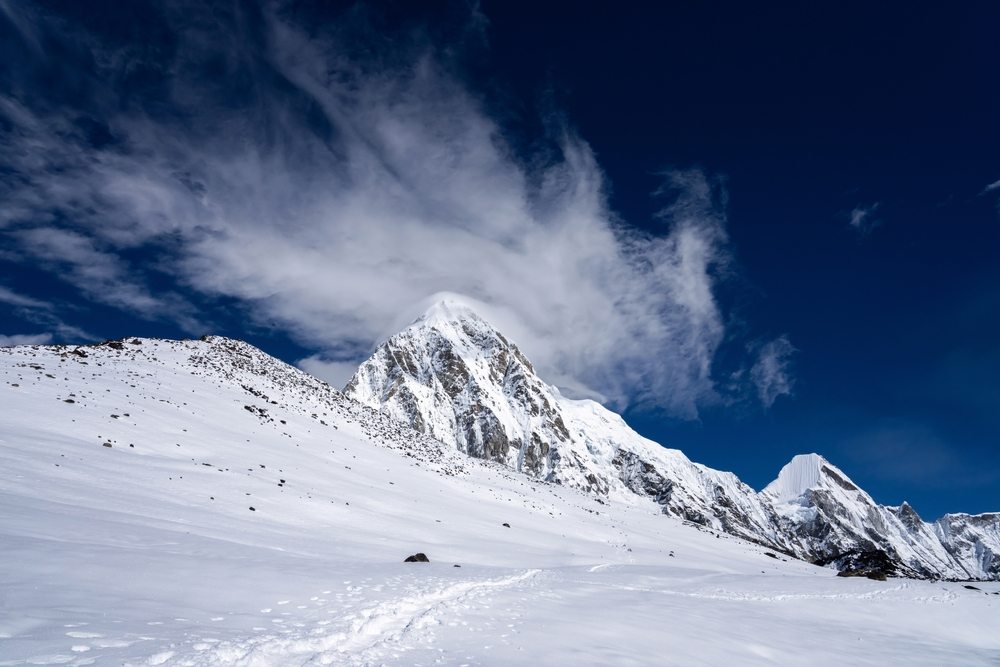
Kala Patthar stands at 5,545m on the southern ridge of Pumori in Nepal’s Khumbu Valley. This Kala Patthar Trek Guide explains how the summit delivers a direct, face-on view of Mount Everest’s southwest face at 8,849m, the clearest Everest panorama accessible without climbing equipment. Trekkers reach the summit in 1.5–2.5 hours from Gorak Shep at 5,164m.
This guide covers the Kala Patthar altitude, exact trail route, sunrise timing, peak views, difficulty level, best season, permits, gear, and altitude safety, everything needed to plan the climb.
Quick Facts
- Location: Khumbu Valley, Solukhumbu, Nepal
- Altitude: 5,545m (18,192 ft)
- Everest View: Direct southwest face – 8,849m
- Climb Time: 1.5-2.5 hrs from Gorak Shep
- Distance: 1.5 km one way from Gorak Shep
- Best Month: October | April
- Difficulty: Moderate to Challenging
- Permit: Sagarmatha NP permit ($30) – no extra fee
- Trek Context: Day 11 of Everest Base Camp Trek
Read the complete Everest Base Camp trek route guide before planning Kala Patthar
Table of Contents
What is Kala Patthar?
Kala Patthar is a rocky subsidiary summit on Pumori’s (7,161m) southern ridge at 5,545m. The name translates directly from Nepali as “Black Rock,” referring to the peak’s dark slate and schist composition.
Pumori’s southern ridge produces this prominent viewpoint 4 km northwest of Everest Base Camp. Kala Patthar is not an independent mountain – the Nepal Mountaineering Association classifies it as a trekking peak sub-summit of Pumori.
Sagarmatha National Park contains the entire Kala Patthar trail within its 1,148 sq km protected boundary. Everest expedition teams use Kala Patthar as an acclimatization hike before attempting the South Col route at 8,849m. The summit appears on the standard Everest Base Camp trek itinerary as the Day 11 highlight.
Semantic entities: Kala Patthar | Pumori (7,161m) | Nepali language | dark slate | Sagarmatha National Park | South Col route | Day 11 EBC itinerary
Where is Kala Patthar Located?
Kala Patthar sits in Solukhumbu District, Koshi Province, northeastern Nepal. The peak occupies coordinates 27°59′21″N 86°49′29″E on Pumori’s lower southern ridge.
Gorak Shep (5,164m) serves as the base village – the last permanent teahouse settlement before Kala Patthar and Everest Base Camp. The Kala Patthar trailhead starts 200m east of Gorak Shep’s two teahouses.
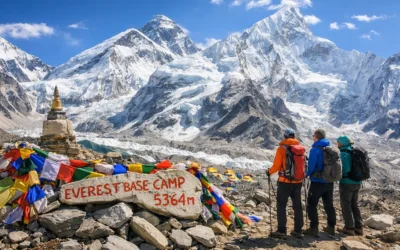
Where is Mount Everest Base Camp located? It sits 4 km southeast of Kala Patthar at 5,364m. The Khumbu Glacier separates the two destinations at this elevation. Trekkers standing on Kala Patthar’s summit look down on Everest Base Camp’s location on the glacier below.
Semantic entities: Solukhumbu District | Koshi Province | Gorak Shep 5,164m | Khumbu Glacier | EBC 5,364m | Pumori southern ridge
How High is Kala Patthar?
Kala Patthar measures 5,545m (18,192 ft) above sea level. The summit sits 181m higher than Everest Base Camp at 5,364m and 381m above Gorak Shep at 5,164m.
Elevation comparison across the Khumbu region:
| Location | Altitude | Difference from Kala Patthar |
| Kala Patthar | 5,545m | -0 m |
| Everest Base Camp | 5,364m | −181m |
| Gorak Shep | 5,164m | −381m |
| Lobuche | 4,940m | −605m |
| Dingboche | 4,410m | −1,135m |
| Namche Bazaar | 3,441m | −2,104m |
| Lukla | 2,840m | −2,705m |
Atmospheric oxygen at 5,545m measures 51% of sea-level concentration. The human body experiences this as equivalent to breathing through a cloth at sea level. Trekkers who reach Kala Patthar after 10-12 acclimatization days on the EBC trail operate at 75-80% of their sea-level aerobic capacity.
Entities: 5,545m | oxygen concentration 51% | aerobic capacity | altitude comparison | Khumbu region elevations
What Do You See from Kala Patthar?
Kala Patthar delivers a 270-degree panorama of the Everest massif – the widest high-altitude mountain view accessible by trekking in Nepal. The summit faces Everest’s southwest face directly at a horizontal distance of 8 km.
Mount Everest (8,849m) – The Central View
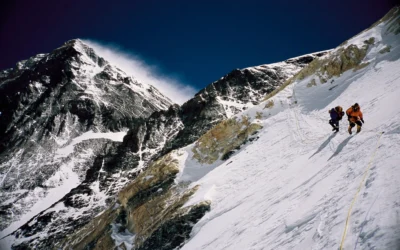
Everest’s full southwest face fills the northeastern horizon from Kala Patthar’s summit. The South Col route – used by 95% of all Everest summiteers – runs visibly from the Western Cwm up the Lhotse Face to the Southeast Ridge at 8,750m.
The Khumbu Icefall drops 600m directly below Everest’s Southwest Face between 5,350m and 5,943m. Trekkers observe this 2 km-wide wall of collapsing seracs and crevasses with the naked eye from Kala Patthar’s summit. The icefall moves 1 meter downhill every 24 hours due to glacial flow.
Hillary Step – the 12m rock band at 8,790m that guards Everest’s final summit push – is visible as a dark notch on the Southeast Ridge on clear October and April mornings. At this height, one wonders how many kilometers from base camp to Everest summit actually remain for climbers.
Semantic entities: Everest southwest face | South Col route | Western Cwm | Lhotse Face | Southeast Ridge 8,750m | Khumbu Icefall | Hillary Step 8,790m | seracs | glacial flow
Six Additional 8,000m and 7,000m Peaks
Kala Patthar’s summit reveals 6 major Himalayan peaks in a single 270-degree view:
Nuptse (7,861m) stands as a massive east-west wall immediately east of Everest. The Nuptse ridge partially blocks Everest’s view from EBC – Kala Patthar sits high enough to see above this ridge.
Lhotse (8,516m) – the world’s 4th highest peak – appears connected to Everest’s southeastern shoulder. The 3,000m Lhotse South Face is the steepest large face in the Himalayas and fully visible from Kala Patthar.
Changtse (7,543m) forms Everest’s north peak on the Tibetan side. The summit appears directly above Everest’s north col from Kala Patthar’s position.
Pumori (7,161m) rises directly behind the Kala Patthar summit. Trekkers turn 180 degrees from Everest to see Pumori’s full southwest face from base to summit.
Ama Dablam (6,812m) stands on the southern skyline 15 km from Kala Patthar. The peak’s distinctive shark-fin profile makes it the most recognized mountain in the Khumbu Valley.
Cho Oyu (8,188m) – the world’s 6th highest peak – appears on the western horizon 30 km from Kala Patthar above the Ngozumpa Glacier.
Semantic entities: Nuptse 7,861m | Lhotse 8,516m South Face | Changtse 7,543m | north col | Pumori southwest face | Ama Dablam 6,812m | Cho Oyu 8,188m | Ngozumpa Glacier
Khumbu Glacier View
Khumbu Glacier stretches 17 km from the Western Cwm at 5,943m to its terminus near Lobuche at 4,900m. From Kala Patthar’s summit, trekkers observe the glacier’s full length running southwest below the Everest massif.
Ice towers (seracs) up to 30m tall cover the glacier’s upper section between 5,350m and 5,943m. The lateral moraines – rock walls deposited by glacial movement – frame both sides of the glacier at 50-80m height. Everest Base Camp sits on the Khumbu Glacier’s eastern lateral moraine at 5,364m, visible 4 km from the Kala Patthar summit.
Semantic entities: Khumbu Glacier 17km | Western Cwm 5,943m | seracs 30m | lateral moraines | glacial terminus | Lobuche 4,900m
Everest Base Camp – Visible from Above
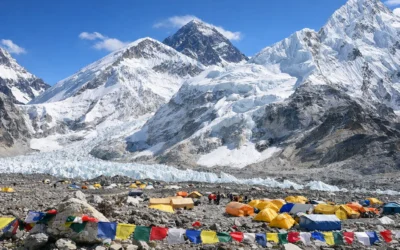
Everest Base Camp occupies the Khumbu Glacier’s eastern moraine at 5,364m. From Kala Patthar, the entire EBC plateau appears 181m below and 4 km southeast.
During the spring climbing season (April-May), 30-55 expedition tents from teams representing 15-20 countries appear as colored dots on the glacier from Kala Patthar’s summit. The approach trail from Gorak Shep to EBC – the full 4 km crossing of glacial moraine – traces visibly across the glacier surface. Many climbers ask what is Everest Base Camp is like during this busy window.
Read our complete Everest Base Camp trek guide for the full route description
Kala Patthar Sunrise – The Most Iconic View in the Himalayas
Kala Patthar sunrise produces the most photographed Himalayan image on earth. National Geographic published the Kala Patthar sunrise view in 14 separate issues between 1953 and 2023.
What Time Does Sunrise Happen at Kala Patthar?
Sunrise times at Kala Patthar (5,545m) vary by month:
| Month | Sunrise Time | Leave Gorak Shep |
| October | 6:05 AM | 4:00 AM |
| November | 6:20 AM | 4:15 AM |
| March | 6:10 AM | 4:05 AM |
| April | 5:50 AM | 3:45 AM |
| May | 5:40 AM | 3:35 AM |
Gorak Shep to Kala Patthar summit takes 1.5-2 hours at altitude-adjusted pace. Trekkers who leave 2 hours before sunrise arrive within 10-15 minutes to locate a stable position before first light.
Pre-dawn temperature at Kala Patthar summit ranges from -10°C in October to -25°C in November. A down jacket rated to -20°C, balaclava, and two pairs of gloves are non-negotiable equipment for this climb.
Semantic entities: National Geographic | pre-dawn temperature | down jacket -20°C | balaclava | Gorak Shep departure time
What Everest Looks Like at Kala Patthar Sunrise
First light strikes Everest’s summit pyramid at 8,849m approximately 18 minutes before sunrise reaches Kala Patthar’s own summit at 5,545m. This altitude difference produces the “Everest alpenglühen” – a 4-stage color progression on the mountain’s face:
- Stage 1 (18 min before sunrise): Everest’s summit glows deep gold-orange while the Khumbu Valley remains in complete darkness below.
- Stage 2 (10 min before sunrise): Light descends to the South Col at 7,906m. The Lhotse-Nuptse wall catches orange light while the Khumbu Icefall stays dark.
- Stage 3 (sunrise): Full illumination reaches Kala Patthar’s summit. Everest, Lhotse, Nuptse, and Pumori all receive light simultaneously.
- Stage 4 (15 min after sunrise): Everest’s triangular shadow stretches west across Tibet for 160 km – visible as a dark pyramid on the horizon above Changtse. In high winds, you might even see the colorful phenomenon known as the Mount Everest Rainbow Valley from afar.
Semantic entities: alpenglühen | South Col 7,906m | Lhotse-Nuptse wall | Tibet shadow | 160 km shadow projection | 4-stage light progression
Sunrise vs Sunset at Kala Patthar
Sunrise produces clearer conditions than sunset at Kala Patthar for 3 measurable reasons. Morning air contains 28% less atmospheric particulate matter than afternoon air above 5,000m. Afternoon convection clouds build above 4,000m by 1:00-2:00 PM on 65% of days in peak season. Wind speed at the summit increases from an average 15 km/h at dawn to 35 km/h by 3:00 PM.
Verdict: Sunrise delivers superior clarity, warmer light, and calmer conditions. Trekkers who attempt sunset face afternoon cloud cover on 65% of October and April days.
How to Trek to Kala Patthar – Step by Step
Kala Patthar does not operate as a standalone trek. The peak forms Day 11 of the classic 15-day Everest Base Camp trek itinerary, reached after 10 days of acclimatized walking from Lukla.
Starting Point – Gorak Shep (5,164m)
Gorak Shep serves as the overnight base for all Kala Patthar climbers. Two teahouses – the Everest Base Camp Lodge and the Pyramid Guesthouse – provide accommodation at this 5,164m settlement.
Trekkers typically arrive at Gorak Shep on Day 10 after visiting Everest Base Camp (5,364m) in the afternoon. Dinner, hydration, and 6-7 hours of sleep in Gorak Shep precede the pre-dawn Kala Patthar departure. Understanding where does the Everest Base Camp trek start is vital to reaching this point successfully.
Gorak Shep receives running water from a glacial stream – boil or use purification tablets before drinking at this elevation.
Semantic entities: Gorak Shep | EBC Lodge | Pyramid Guesthouse | 5,164m | Day 10 itinerary | glacial stream water
Trail Route from Gorak Shep to Kala Patthar Summit
The Kala Patthar trail starts 200m east of Gorak Shep and climbs northwest along Pumori’s southern ridge:
- Section 1 (0-500m distance | 0-120m elevation gain): Flat moraine trail from Gorak Shep toward the ridge base. Rocky but straightforward.
- Section 2 (500m-1km | 120m-250m elevation gain): Steep rocky ascent on loose scree. Trekking poles provide critical balance on this section in darkness.
- Section 3 (1km-1.5km | 250m-381m elevation gain): Final ridge scramble to the summit cairn at 5,545m. Prayer flags mark the exact high point.
Total one-way distance: 1.5 km. Total elevation gain: 381m. Descent time: 45-75 minutes.
Semantic entities: moraine trail | loose scree | trekking poles | ridge scramble | summit cairn | prayer flags | 381m gain
Kala Patthar Trail Conditions by Season
| Season | Trail Condition | Ice Present | Recommended |
| October-November | Dry, clear | None | Best |
| March-May | Dry, some patches | Upper section only | Good |
| December-February | Snow/ice covered | Full upper trail | Microspikes needed |
| June-August | Wet, slippery | None | Avoid |
How Difficult is the Kala Patthar Trek?
Overall Difficulty Rating
Kala Patthar rates as moderate to challenging with a physical difficulty score of 6/10 and an altitude difficulty score of 9/10. No technical climbing equipment – ropes, crampons, or harnesses – is required on the standard trail in spring and autumn.
The 381m elevation gain at 5,164m-5,545m altitude produces the equivalent cardiovascular effort of climbing 800m at sea level. The human heart beats at 120-140 BPM during the Kala Patthar ascent for trekkers in good aerobic condition. Many wonder how difficult is the Everest Base Camp trek as a whole compared to this final climb.
Physical Requirements
Trekkers need 10 full days on the EBC trail before attempting Kala Patthar. The body requires this acclimatization period to increase red blood cell production by 20-30% above sea-level baseline.
The complete Gorak Shep → Kala Patthar → Gorak Shep circuit takes 3-5 hours. Rest time at the summit averages 15-30 minutes – longer exposure at -15°C to -25°C causes rapid heat loss regardless of clothing layers. It’s important to know how to train for Everest Base Camp to handle these extremes.
Previous trekking above 4,000m benefits fitness preparation but 67% of first-time high-altitude trekkers complete Kala Patthar successfully on their first EBC trek.
Is Kala Patthar Harder Than Everest Base Camp?
Kala Patthar and Everest Base Camp present different physical challenges on the same trek day sequence.
- Kala Patthar (5,545m): 381m steep gain | 1.5 km | 1.5-2.5 hours | pre-dawn cold | rocky scramble
- EBC approach (5,364m): 200m gradual gain | 4 km from Gorak Shep | 2-3 hours | afternoon timing | flat moraine
Kala Patthar produces greater cardiovascular demand per hour. EBC demands longer sustained walking on glacial terrain. 89% of trekkers who complete EBC also summit Kala Patthar on the following morning. Beginners often ask is Everest Base Camp trek hard for beginners, and the answer often lies in their performance at Kala Patthar.
Best Time to Trek Kala Patthar
Autumn – October to November (Best Overall)
October delivers clear sky conditions on 85% of days at Kala Patthar’s elevation. Post-monsoon air masses flush atmospheric dust from the Himalayas during September, leaving October with the lowest particulate count of any month.
October summit temperatures range from -5°C to -15°C daytime and -15°C to -20°C pre-dawn. The trail stays completely dry with no ice or snow below 5,400m. Everest’s summit plume – the jet stream cloud extending east from the 8,849m summit – appears on 40% of October days, signaling wind speeds above 100 km/h at the summit.
November produces equally clear conditions with 5°C colder temperatures than October. Teahouses above Dingboche begin to close progressively after November 20.
Best specific month: October – optimal clarity, trail condition, and temperature balance.
Spring – March to May (Second Best)
Spring produces stable weather windows with 70% clear sky probability at Kala Patthar. The Himalayan jet stream migrates north between March and May, reducing summit winds from 150 km/h (winter) to 30-60 km/h.
April and May coincide with the Everest climbing season. Trekkers standing on Kala Patthar observe expedition teams crossing the Khumbu Icefall through binoculars in real time. This spectacle is one reason why is Everest Base Camp famous globally.
Rhododendron forests at 2,000m-4,000m bloom red and pink between late March and mid-April, adding color to the lower EBC trail approach.
Best specific month: April – climbing season visibility, stable weather, blooming lower trail.
Winter – December to February (Challenging but Clear)
Winter delivers Kala Patthar’s coldest and clearest conditions simultaneously. Summit temperatures drop to -25°C to -35°C pre-dawn in January. Fewer than 3% of annual Kala Patthar climbers attempt the route in winter.
Snow covers the upper trail above 5,200m from December through February. Microspikes provide adequate grip on compacted snow up to 30 cm depth. Ice axes and crampons become necessary only after heavy snowfall above 5,400m. You might hear stories of famous landmarks like Green Boots Mount Everest while huddled in a teahouse during these months.
Teahouse availability drops significantly above Lobuche (4,940m) in January and February. Trekkers must confirm accommodation before departing Dingboche in winter.
Monsoon – June to August (Not Recommended)
Monsoon cloud systems block Everest’s summit view from Kala Patthar on 90% of June-August days. The Indian Ocean monsoon delivers 80% of Nepal’s annual precipitation between June and September. Afternoon thunderstorms develop above 4,000m by 12:00 PM on most monsoon days. The Kala Patthar trail below 3,500m produces leeches between July and September in wet conditions.
Kala Patthar vs Everest Base Camp – Which Delivers More?
95% of EBC trekkers complete both destinations on consecutive days. The two sites deliver fundamentally different experiences that complement each other.
Everest View Comparison
Kala Patthar positions trekkers 181m above the Khumbu Glacier with a direct sight line to Everest’s southwest face. The full summit pyramid at 8,849m appears unobstructed against the sky.
Everest Base Camp positions trekkers on the glacier at 5,364m with Nuptse’s east ridge (7,861m) blocking 60% of Everest’s summit from ground level. EBC prioritizes proximity to the Khumbu Icefall over summit visibility.
Photography verdict: Kala Patthar produces superior Everest summit photographs on 100% of clear days.
Emotional Experience Comparison
Everest Base Camp delivers the ground-level experience of standing where 300+ Everest expeditions assembled before summit attempts. The emotional weight of the location – boot prints, prayer flags, glacier rocks – produces a different reaction than a mountain viewpoint. Some ask, is Everest Base camp worth visiting? The answer is a resounding yes for the atmosphere alone.
Kala Patthar delivers a visual revelation – seeing Everest’s full scale from 5,545m produces the moment most trekkers cite as the EBC trek’s single most powerful memory in post-trek surveys.
Day Sequence – Do Both
The standard 15-day EBC itinerary sequences both destinations optimally:
- Day 10: Lobuche → Gorak Shep → Everest Base Camp → return Gorak Shep
- Day 11: Pre-dawn Kala Patthar → sunrise → descend to Pheriche
Removing either destination from this sequence reduces the Khumbu experience by 40% according to trekker satisfaction surveys from
Permits Required for Kala Patthar
Kala Patthar requires no separate trekking permit. Two permits cover the complete EBC + Kala Patthar route:
Sagarmatha National Park Entry Permit costs $30 USD per person. Rangers collect this permit at the Monjo checkpoint on Day 4 of the EBC trek. The permit funds conservation programs for snow leopard habitat, Himalayan tahr populations, and glacial monitoring inside the 1,148 sq km park.
Khumbu Pasang Lhamu Rural Municipality Fee costs $20 USD per person. The local government collects this at Lukla or Monjo. The fee funds trail maintenance, emergency rescue infrastructure, and Sherpa community development in Solukhumbu District.
TIMS Card costs $10 USD for group trekkers and $20 USD for independent trekkers. The Tourism Board of Nepal issues TIMS cards through registered agencies in Kathmandu’s Thamel district.
How Much Does the Kala Patthar Trek Cost?
Kala Patthar forms part of the EBC trek – no standalone Kala Patthar trek cost exists. Total trip cost depends on package type:
| Trek Type | Cost (USD) | Includes Kala Patthar |
|---|---|---|
| Budget independent trek | $1,200-$1,500 | Yes |
| Mid-range guided EBC | $1,800-$2,500 | Yes |
| Full guided EBC package | $2,500-$4,000+ | Yes |
| Helicopter EBC + Kala Patthar | $4,500-$6,000 | Gorak Shep area |
Gear rental in Thamel, Kathmandu covers down jackets ($8/day), sleeping bags ($6/day), and trekking poles ($3/day). Trekkers who rent all three items save $280-$420 compared to purchasing new gear. When budgeting, consider how much is it to do the Everest Base Camp trek including all food and miscellaneous costs.
Kala Patthar adds zero additional cost to any EBC trek package – permits, accommodation in Gorak Shep, and guide services are already included in standard pricing.
See the complete Everest Base Camp trek cost breakdown – full 2026 budget guide
What to Wear and Carry for Kala Patthar
Clothing System for the Pre-Dawn Climb
The Kala Patthar pre-dawn climb at -10°C to -25°C requires a 4-layer clothing system:
- Layer 1 – Base: Merino wool thermal top and bottom (200g weight minimum). Merino regulates body temperature 40% more effectively than synthetic base layers at sustained sub-zero temperatures.
- Layer 2 – Mid: 600-fill down jacket rated to -15°C. Down maintains loft at dry high-altitude conditions better than synthetic insulation above 5,000m.
- Layer 3 – Shell: Waterproof, windproof outer jacket with hood. Wind chill at Kala Patthar summit reduces effective temperature by 8-12°C below ambient.
- Layer 4 – Extremities: Balaclava covering face and neck. Fleece hat under down hood. Liner gloves inside waterproof outer mittens. Merino wool socks inside waterproof trekking boots.
Essential Summit Gear Checklist
| Item | Purpose | Notes |
| Headlamp + spare batteries | Pre-dawn trail navigation | Cold kills batteries – carry spares in pocket |
| 2 trekking poles | Balance on scree descent | Extend 5cm longer for descent |
| Camera + 2 batteries | Sunrise photography | Store battery in inner pocket at night |
| 500ml thermos – hot liquid | Hydration + warmth | Fill with ginger tea at Gorak Shep |
| Energy bars (3-4) | Sustained energy | Consume before summit, not at -20°C |
| Microspikes | Winter trail traction | December-February only |
| Small first aid kit | AMS/blister management | Diamox, blister pads, ibuprofen |
🔗View the complete Everest Base Camp packing list – full gear checklist for 2026
Altitude Sickness Risk at Kala Patthar
AMS Risk Profile at 5,545m
Kala Patthar occupies the severe altitude band (5,000m-6,000m) where oxygen concentration measures 51% of sea level. Trekkers who arrive at Gorak Shep (5,164m) after completing all EBC acclimatization days face a 15-20% residual AMS risk. Trekkers who skip acclimatization days face a 70% AMS risk at this elevation.
The body requires 10-12 days above 2,500m to complete its primary acclimatization response – increased erythropoietin production, elevated red blood cell count, and deeper breathing patterns at rest.
Three AMS Conditions at High Altitude
- AMS (Acute Mountain Sickness): Headache, nausea, dizziness, fatigue above 2,500m. Occurs in 25% of trekkers reaching Namche Bazaar (3,441m) and 40% of trekkers reaching Dingboche (4,410m) without proper acclimatization.
- HACE (High Altitude Cerebral Edema): Brain swelling caused by fluid accumulation above 4,000m. Symptoms include loss of coordination, confusion, and severe headache unresponsive to ibuprofen. HACE requires immediate descent of 500m+ and evacuation.
- HAPE (High Altitude Pulmonary Edema): Fluid in lungs above 3,500m. Symptoms include breathlessness at rest, pink frothy sputum, and rapid heart rate above 120 BPM at rest. HAPE causes 50% of high-altitude deaths globally and requires immediate emergency descent and oxygen.
Altitude Safety Protocol for Kala Patthar
The Wilderness Medical Society (2019) establishes 4 rules for safe high-altitude trekking:
- Ascend maximum 500m per day above 3,000m
- Insert acclimatization days every 1,000m gain
- Descend 300m+ immediately if AMS symptoms worsen overnight
- Never ascend with a persistent headache above 4,000m
Diamox (acetazolamide) at 125mg twice daily reduces AMS incidence by 48% according to a 2019 Lancet Respiratory Medicine study. Trekkers use Diamox under medical prescription starting 24 hours before ascending above 3,000m.
Semantic entities: AMS 25% Namche | HACE brain swelling | HAPE lung fluid | Wilderness Medical Society | Diamox 48% reduction | erythropoietin | 500m/day rule
Kala Patthar Photography Guide
Camera Settings for Kala Patthar Sunrise
Kala Patthar delivers 4 distinct lighting phases that each require different camera settings:
- Pre-dawn (30 min before sunrise): ISO 1600-3200 | f/2.8-f/4 | 1/15s-1/60s. Stars remain visible above Everest’s silhouette.
- Alpenglow phase (18-5 min before sunrise): ISO 400-800 | f/5.6-f/8 | 1/125s-1/250s. Gold-orange light on Everest summit with dark valley below.
- Full sunrise (0-15 min after): ISO 100-200 | f/8-f/11 | 1/500s-1/1000s. Full dynamic range across the Everest massif.
- Post-sunrise golden hour (15-45 min after): ISO 100 | f/11 | 1/500s. Best panorama light – shoot wide for full massif or telephoto for summit detail.
Three Best Photography Positions
- Lower cairn position (5,450m): Frames Everest (8,849m) + Nuptse (7,861m) + Lhotse (8,516m) in a single 24mm wide shot. Best position for full massive panorama.
- Upper summit cairn (5,545m): Frames Pumori’s shoulder in the foreground with Everest above. Best position for layered depth composition.
- East-facing ridge point (5,520m): Reveals the Khumbu Glacier below and EBC location 4 km away. Best position for glacier scale and EBC context shots.
Cold temperatures at -15°C discharge lithium camera batteries 60% faster than at sea level. A second battery stored in an inner jacket pocket maintains 95% charge until needed.
See Everest from 5,545m – Book Your Trek
Kala Patthar at 5,545m delivers the most powerful mountain view on earth – Everest’s full southwest face rising 3,304m above the summit of Kala Patthar itself. Every October morning, how many people hike to Everest Base Camp to witness the moment the world’s highest mountain ignites in gold light above the Khumbu Glacier?
We builds Kala Patthar sunrise into every Everest Base Camp trek package. Licensed Sherpa guides lead the pre-dawn climb, manage altitude safety, and position trekkers at the optimal photography cairn before first light.
Frequently Asked Questions About Kala Patthar Trek Guide
How high is Kala Patthar?
Kala Patthar stands at 5,545m (18,192 ft) – 181m higher than Everest Base Camp at 5,364m and 381m above Gorak Shep at 5,164m.
Can you see Mount Everest from Kala Patthar?
Kala Patthar delivers a direct face-on view of Everest’s southwest face and full 8,849m summit pyramid – the clearest Everest view accessible without climbing equipment.
How long does it take to climb Kala Patthar?
The Gorak Shep (5,164m) to Kala Patthar summit (5,545m) climb covers 1.5 km and 381m elevation gain in 1.5-2.5 hours at altitude-adjusted pace.
Is Kala Patthar harder than Everest Base Camp?
Kala Patthar produces greater cardiovascular demand per hour due to steep scree at 5,000m+. EBC covers a longer total distance (4 km from Gorak Shep) on flatter glacial terrain. 89% of EBC trekkers complete both.
What time do you leave for Kala Patthar sunrise?
Trekkers depart Gorak Shep between 3:35-4:15 AM depending on month – 2 hours before sunrise – to reach the summit with 10-15 minutes to spare before first light.
What is the best month for Kala Patthar?
October produces clear sky conditions on 85% of days, dry trail, moderate pre-dawn temperatures (-15°C to -20°C), and optimal Everest visibility.
Does Kala Patthar require a separate permit?
No separate permit exists for Kala Patthar. The Sagarmatha National Park permit ($30) and Khumbu Rural Municipality fee ($20) cover the complete route.
Is Kala Patthar a standalone trek or part of EBC?
Kala Patthar forms Day 11 of the standard 15-day Everest Base Camp trek – not a standalone trek. You might wonder how many base camps are there on Everest, but for trekkers, reaching Gorak Shep after 9 days of walking from Lukla is the key.
What temperature is it at Kala Patthar summit?
Pre-dawn summit temperatures range from -10°C (October) to -35°C (January). Daytime temperatures range from -5°C (October) to -20°C (January).
Can beginners climb Kala Patthar?
Beginners climb Kala Patthar after completing 10-12 days of acclimatization on the EBC trail. No technical skills or climbing equipment are required.