Going vegetarian and worried about the Everest Base Camp trek? You can relax. This trek is actually one of the easiest high-altitude hikes in the world for people who don’t eat meat. Nepal has a long history of vegetarian cooking, and the mountains make meat hard to serve safely anyway. So the two things line up perfectly.
Vegetarian food is easy to find on the Everest Base Camp trek. Every teahouse along the trail serves dal bhat, veggie noodles, fried rice, momos, soup, and potato dishes every single day. If your meals aren’t included in your trek package, plan to spend around $25 to $40 a day on food. Once you pass Namche Bazaar, going vegetarian is actually the smarter choice, since there’s no real refrigeration up there and any meat has to be carried in on someone’s back for days before it reaches your plate.
In this guide, we’ll walk through teahouse menus, the famous dal bhat, vegan swaps, snacks worth packing, what things cost, water safety, a full sample meal plan, and answers to the questions trekkers ask most.
Table of Contents
Is It Easy to Be Vegetarian on the Everest Base Camp Trek?
Yes. It’s easy. Most trekkers end up eating dal bhat, veggie noodles, fried rice, momos, and soup almost every day, whether they planned to or not.
Here’s why it works out so well:
- Nepal already eats mostly vegetarian. Many Hindu and Buddhist families in Nepal skip meat on a regular basis, so cooks are used to making full, satisfying meals without it.
- Fresh meat gets rare the higher you climb. Above Namche Bazaar, there are no roads. Everything is carried in by porters or yaks, so meat that isn’t fresh becomes a real risk.
- The whole menu is built around plants already. Rice, lentils, potatoes, noodles, and vegetables are the backbone of nearly every teahouse menu on the trail, not an afterthought.
There’s a safety bonus here too. Vegetarian meals are usually cooked fresh, right when you order them, and they tend to sit easier on your stomach at altitude than heavier meat dishes.
Why Teahouses Push Vegetarian Food at High Altitude
This isn’t just a lucky coincidence for vegetarians. There are real, practical reasons why teahouses lean so heavily on plant-based meals the higher you go.
Fresh Meat Can’t Survive the Journey
Every bag of rice, every vegetable, and yes, every piece of meat that reaches a teahouse above Lukla has to be flown in and then carried by porter or yak. There’s no truck route, no cold chain, and no daily delivery. By the time meat arrives at a village like Dingboche or Lobuche, it may have been traveling for days in a basket on someone’s back. That’s exactly the kind of situation that causes food poisoning. Most experienced guides will tell you straight up: skip the meat once you’re past Namche.
No Refrigeration Above Namche Bazaar
Most lodges above Namche run on solar panels or small generators, and full-size refrigerators are rare. A few teahouses keep small coolers for eggs or dairy, but there isn’t reliable, powered cold storage the way you’d expect at home. Eggs and small amounts of dairy are usually fine because they’re used up quickly, but meat is a much bigger gamble. This is really why menus quietly shift toward vegetarian dishes as you climb.
Digestion Slows Down at Altitude
Here’s the simple version: your body is working overtime just to breathe at 4,000 or 5,000 meters, so it has less energy left over to digest a heavy meal. Rich, greasy, or meat-heavy food can sit like a rock in your stomach.
Lighter food works better:
- Carbs like rice, noodles, and potatoes give you quick, usable energy.
- Lentils (the “dal” in dal bhat) give you protein without weighing you down.
A good rule on this trek: eat smaller, warm meals more often instead of three huge ones.
Everest Base Camp Vegetarian Food List (Breakfast, Lunch, Dinner)
Teahouse menus look almost identical from Lukla all the way to Gorak Shep, just with fewer choices and higher prices the higher you climb. Here’s what you’ll actually see on the page.
Breakfast Options
| Dish | Why it’s good |
| Porridge / oats | Warm, gentle on the stomach, easy to finish even with low appetite |
| Tibetan bread | Filling and carb-heavy (skip the butter if you’re avoiding dairy) |
| Chapati / roti | Light carbs, pairs well with a small veg curry |
| Pancakes | Comforting with jam or honey (skip the cheese topping) |
| Boiled or fried eggs | Good protein boost if you eat eggs |
| Muesli with hot milk or water | Quick to prepare, decent fiber |
| Hot drinks | Black tea, ginger tea, lemon tea, coffee, all help with hydration |
Lunch & Dinner Options
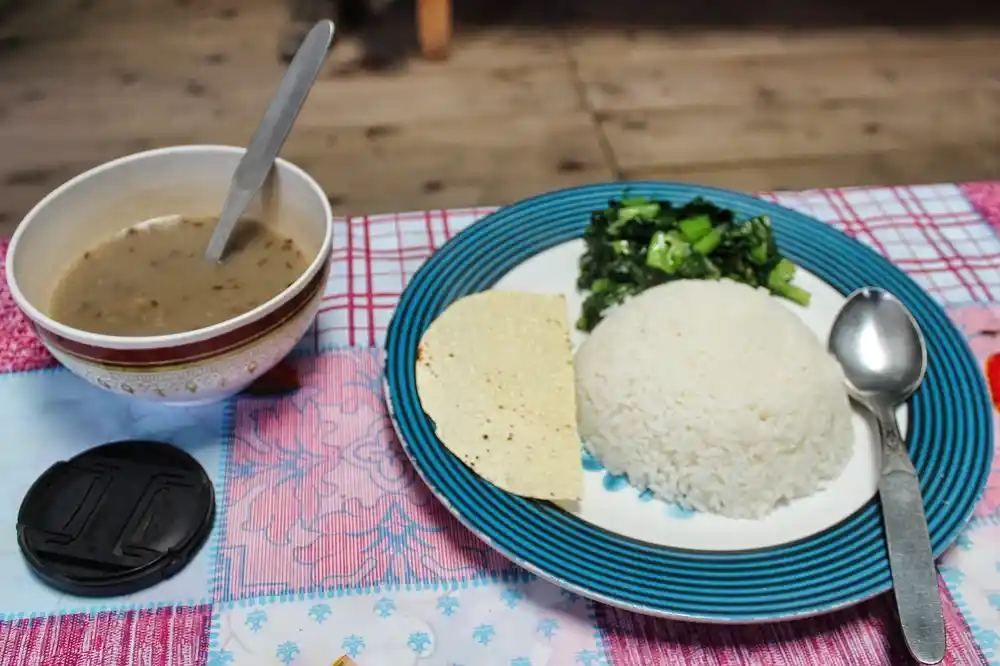
- Dal Bhat – Rice, lentil soup, a vegetable curry, and pickle, with unlimited refills at most teahouses.
- Vegetable fried rice – Carbs plus veggies (ask for no egg if you’re vegan).
- Veg noodles / chow mein – Quick, filling, and everywhere on the trail.
- Veg momos – Steamed dumplings; always double-check the filling has no meat.
- Vegetable soup or garlic soup – Warm and hydrating, especially good at dinner.
- Pasta with tomato sauce – Simple and widely available, even at higher villages.
- Potato dishes – Sherpa stew, fried potatoes, or aloo curry.
- Thukpa or Thenthuk – Hearty noodle soup, a Sherpa classic and a common dinner pick.
- Tsampa – Roasted barley flour, a traditional high-energy Tibetan food.
Most trekkers settle into a pattern fast: dal bhat once a day, then noodles, fried rice, or soup for the other meal.
Best Vegetarian Dish on the Trek: Dal Bhat Explained
If you eat only one thing on this trek, make it dal bhat.
What’s in it: steamed rice, lentil soup (dal), a vegetable curry (tarkari), pickle (achar), and sometimes a bit of yogurt on the side.
Why guides swear by it:
- Most teahouses give you free refills, so it’s the best value meal on the whole trail.
- It naturally balances carbs, protein, and vegetables in one plate.
- It’s warm, simple, and easy on the stomach after a long day of walking.
Think of dal bhat as Nepal’s version of comfort food for trekkers, it’s what your guide and porters will be eating too. Save it for lunch or dinner, the meals where you need the most fuel in your tank.
Going vegan? Just ask for no ghee and no yogurt, and plain dal bhat becomes a fully vegan meal.
Vegan Options on the Everest Base Camp Trek
Trekking vegan on EBC is very doable, but you do need to ask the right questions, because hidden dairy shows up in more places than you’d expect: ghee (clarified butter), milk, yak cheese, curd or yogurt, butter mixed into bread and pancakes, and egg stirred into fried rice or noodles.
Dishes that are safely vegan once you ask:
- Plain dal bhat (no ghee, no yogurt)
- Vegetable fried rice (no egg, no butter)
- Veg noodles or chow mein (no egg, no butter)
- Vegetable soup or garlic soup
- Pasta with tomato sauce (no cheese)
- Steamed veg momos (confirm the filling)
- Porridge made with water instead of milk
- Chapati without butter
- Tibetan bread without butter or honey
- Boiled or fried potatoes, or potato curry
A few simple Nepali phrases that help a lot:
- “Dudu chhaina” = no milk
- “Gheu chhaina” = no ghee
- “Anda chhaina” = no egg
Some vegan trekkers also carry a small card or note with these phrases written down, since not every cook speaks fluent English and pointing at written words is faster than explaining every time. Bringing your own nutritional yeast or a small bag of protein powder can also help stretch out plain rice-and-veg meals into something more filling.
Gluten-free note: Rice-based dishes like dal bhat and fried rice, plus potatoes and clear soups, are usually gluten-free. Bread and momos almost always contain gluten, so skip those if you need to avoid it.
Bottom line: yes, you can absolutely trek to Everest Base Camp as a vegan. Just get comfortable asking for “no ghee, no milk, no egg” at every meal, and tell your guide about your diet on day one so they can help coordinate with teahouse kitchens ahead of time.
What Vegetarian Trekkers Should Avoid
A few things are worth steering clear of, especially once you’re above Namche:
- Meat and unpasteurized dairy above Namche. Without reliable cold storage, this is where food poisoning risk climbs fastest.
- Raw salads or uncooked vegetables. The water used to wash them may not be treated, which raises the germ risk.
- Unfiltered water or ice. Stick to boiled or treated water only ice cubes are not safe.
- Heavy fried food at high altitude. It can sit heavily and slow your digestion right when your body needs to be efficient.
- Unpasteurized dairy in general. Higher contamination risk, especially the higher you climb.
- Alcohol. It dehydrates you and can make altitude symptoms worse. Save the celebration drink for Kathmandu.
- Street-style snacks in Lukla or Namche. Hygiene varies a lot outside of busy, well-reviewed teahouses, so stick to places with steady foot traffic.
How to Get Enough Protein and Energy as a Vegetarian
Here’s something a lot of first-time trekkers don’t expect: your body burns roughly 3,000 to 4,500 calories a day on this trek, but most people only manage to eat 2,000 to 3,000. That gap is normal, but it’s also exactly why planning your food matters.
A few things to know:
- Your appetite will likely drop once you’re above 4,000 meters. This is common, not a sign something’s wrong but it means you need calorie-dense snacks on hand, since a small appetite paired with skipped meals is a bad combination. This is part of how difficult the trek can feel at altitude.
- Carbs digest more easily at altitude. Rice, noodles, and potatoes are your best friends up here.
- Lentils (dal) are your main protein source, so eat dal bhat daily if you can.
- Eggs are a solid protein boost at breakfast if you eat them boiled or as an omelet.
- Peanut butter, nuts, and seeds are calorie-dense and worth bringing from Kathmandu.
- Protein bars are useful backup, pack around 10 to 14 for a 12 to 14 day trek.
- Smaller, more frequent meals (4 to 6 a day) tend to work better than three big ones when your appetite is low.
- A daily multivitamin is worth considering for a trek this long, just to cover any nutritional gaps.
- Water and carbs go together. Aim for 3 to 4 liters of water a day, and lean on rice, noodles, and potatoes for steady energy. Good fitness preparation helps your body handle this demand.
Snacks to Pack From Kathmandu (Before You Start)
Prices go up and choices shrink the higher you climb, so it pays to stock up before you even start walking.
Smart snacks to bring:
- Nuts (almonds, walnuts, peanuts)
- Dried fruit (raisins, apricots, mango)
- Protein bars (10 to 14 for the trek)
- Dark chocolate for a quick energy hit
- Peanut butter, in a small jar or single-serve sachets
- ORS or electrolyte packets
- A small bag of nutritional yeast or plant-based protein powder, especially if you’re vegan
A useful rule of thumb: carry around 300 to 500 extra calories of snacks per day as backup, on top of your regular meals. And buy what you can in Kathmandu, trail prices climb fast once you’re a few days in.
Sample 1-Day Vegetarian Meal Plan on the EBC Trek
| Time | Meal | Example |
| 7–8 AM | Breakfast | Porridge with hot water, black tea, and one chapati with veg curry |
| 10 AM | Snack | A handful of nuts and dried fruit |
| 12–1 PM | Lunch | Dal bhat (rice, dal, tarkari, achar) with ginger tea |
| 3 PM | Snack | Protein bar with hot lemon tea |
| 6–7 PM | Dinner | Veg noodles or garlic soup with Tibetan bread |
| Before bed | Wind-down | Warm water or herbal tea (skip the alcohol) |
Adjust the portions to your own hunger and how you’re feeling at altitude, some days you’ll eat more, some days a lot less, and both are normal.
Food Safety Tips for Vegetarian Trekkers at Altitude
- Eat hot, freshly cooked food only. Skip anything that’s been sitting out.
- Only drink boiled or treated water. Use purification tablets or a filter, and avoid ice completely.
- Use hand sanitizer before meals. It’s a small habit that cuts down on stomach bugs a lot.
- Peel your own fruit. Bananas and oranges are safer once you’ve peeled them yourself.
Water purification options and rough costs:
- Boiled water from a teahouse: $1 to $5, and it gets pricier the higher you go
- Purification tablets or drops: cheap and light to carry
- Filter bottles or a SteriPEN: reusable and better for the environment
- Bottled water: around $1 near Namche, but up to $5 or more near Gorak Shep
A quick correction worth knowing: Nepal’s 2020 rule for the Khumbu region banned single-use plastics thinner than 30 microns, things like plastic bags, straws, and soda bottles, but it specifically exempted plastic water bottles, since there wasn’t yet an easy way to refill from larger containers up there. So don’t count on plastic water bottles disappearing from shelves. Bringing your own filter or purification tablets is still the cheaper and greener choice either way.
If you get an upset stomach:
- Rest, and sip ORS or a salty-sweet rehydration mix.
- Stick to plain dal bhat, soup, or plain rice until you feel better.
- Tell your guide right away, and be ready to descend if symptoms get worse instead of better.
How Much Does Vegetarian Food Cost on the Everest Base Camp Trek?
If your teahouse meals aren’t included in your trek package, plan on roughly $25 to $40 a day for food, more if you’re ordering Western dishes or extras, and less if you stick mostly to dal bhat.
Low altitude (Lukla to Namche, roughly 2,800–3,440m)
- Dal bhat (veg): $5–7 (NPR 500–800)
- Noodles or fried rice: $4–6
- Breakfast (porridge, eggs, toast): $3–5
- Tea or coffee: about $1.50
Mid altitude (Tengboche to Dingboche, roughly 3,800–4,400m)
- Dal bhat (veg): $7–9 (NPR 800–1,000)
- Noodles or fried rice: $6–8
- Breakfast: $5–7
- Tea or coffee: $2–3
High altitude (Lobuche to Gorak Shep, roughly 4,900–5,160m)
- Dal bhat (veg): $9–12 (NPR 1,000–1,400)
- Noodles or fried rice: $8–10
- Breakfast: $6–9
- Tea or coffee: up to $5
Prices climb the higher you go simply because everything has to travel by porter or yak over several days, and fuel for cooking gets more expensive too. One easy money-saving tip: eat dal bhat twice a day. It’s the best value on the mountain, and the free refills mean you’re never left hungry.
Insights You Won’t Find in Most Guides
- Cooking oil often gets reused at smaller teahouses. It’s worth going easy on deep-fried food, especially higher up.
- Dairy gets harder to digest above roughly 4,400 meters, since your gut has less oxygen and energy to work with. Leaning plant-based by default up there is genuinely the safer call, not just a preference.
- A thermos or insulated bottle filled with boiled water at night does double duty: it keeps you hydrated and works as a warm bottle to tuck into your sleeping bag, especially when weather gets harsh at night.
- Cooks are usually more flexible than the menu suggests. Politely asking for “less spicy,” “no garlic,” or “extra broth” is normal and welcomed, especially if you mention it when you order rather than after the food arrives.
- Bakery treats show up at Namche and Lobuche. A slice of apple pie or a fresh baked good is a small but real morale boost on a hard day.
- Tell your guide about your diet on day one. Guides and Sherpas who know ahead of time can flag your needs to teahouse kitchens before you even arrive, which means fewer surprises and faster meals.
Final Tips
- Keep it simple: dal bhat, noodles, and potatoes are a winning combination you can lean on the whole trek.
- Listen to your body and eat small, warm meals often, even when your appetite dips.
- Always carry backup snacks: nuts, bars, and a little chocolate go a long way.
- Speak up clearly: “no ghee, no milk, no egg” works almost everywhere.
Next, check out our full EBC packing list and 15-day itinerary to finish planning your trek.
Frequently Asked Questions
Is dal bhat vegan?
Plain dal bhat can be vegan. Ask for no ghee in the dal and skip the yogurt on the side. Everything else on the plate is plant-based.
Can I survive on vegetarian food for 12–14 days at EBC?
Yes. Thousands of trekkers do it every season, and most locals eat this way year-round. You’ll get plenty of carbs, enough protein from lentils and eggs, and more variety than you expect.
What if a teahouse has no vegetarian menu items?
This almost never happens. Every teahouse has rice, dal, potatoes, and noodles. Just ask for them without meat or egg and the kitchen will sort you out.
Is meat safe to eat on the Everest Base Camp trek?
Below Namche, it’s usually fine. Above Namche, vegetarian is the safer choice. Meat is carried for days with no refrigeration, and food poisoning at altitude is serious.
Do teahouses understand vegan requests?
Yes, if you keep it simple. “No milk, no ghee, no egg” works everywhere. Have your guide explain it to the kitchen on the first night, and it usually gets easier from there.
What vegetarian food gives the most energy?
Dal bhat is the best all-round choice. Fried rice, noodles, and potato dishes are close behind. For snacks, peanut butter, nuts, and dark chocolate pack the most calories per gram.
How much water should I drink as a vegetarian trekker?
Aim for 3–4 liters a day, more on sunny or windy days. Soups and hot teas count toward the total.
Is gluten-free food available on the EBC trek?
Yes. Dal bhat, fried rice, potato dishes, and clear vegetable soups are naturally gluten-free. Avoid bread, momos, pasta, and noodle soups.
Do I need to tell my trekking company I’m vegetarian?
It helps, especially if meals are included. But you’ll order from the menu yourself at each teahouse, so you stay in control either way.