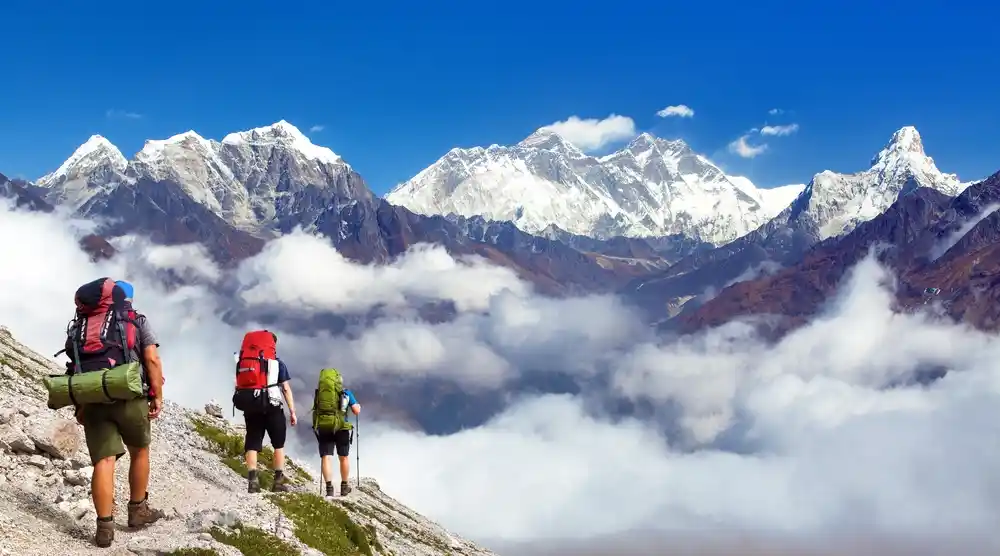
With a porter, carry 5–7 kg (11–15 lb) in your daypack and let the porter carry 12–13 kg (26–29 lb) in a duffel. Without a porter, plan for 8–12 kg (18–26 lb) in a 50–65 L pack. The Lukla flight caps you at 10 kg checked + 5 kg cabin, and that limit decides what makes the plane.
That is the simple version. The rest of this guide shows you exactly what goes in each bag, why the right number changes with altitude, and the ten packing mistakes that put most trekkers over the limit before they reach Namche.
Table of Contents
The Weight Triangle: Body, Porter, Aircraft
Every EBC packing choice sits inside three limits. They all pull at each other.
- Your body. Above 4,000 m, the air is thin. Your lungs and legs get less oxygen. Every extra kilo costs more than it does at home.
- The porter’s body. The rule in Nepal is 25 kg per porter. Two trekkers share one porter. Above 5,000 m, the on-the-ground limit drops to about 20 kg.
- The aircraft. Yeti, Tara, Sita, and Summit Air all allow 10 kg + 5 kg on the Lukla flight. Extra weight costs USD 1–2 per kilo.
The trick is to make all three numbers line up. This guide shows you how.
Why a Heavy Pack Hurts More at Altitude
A heavy pack is bad at sea level. At 5,000 m, it is worse.
A 1981 US Army study tested walkers at 4,300 m. Some carried 30 kg. Some carried 15 kg. All walked up a steep hill.
- The 30 kg group gave out in 4.2 minutes.
- The 15 kg group lasted 7.3 minutes.
The same weight costs more oxygen when the air is thin.
A field test by Mountain Tactical Institute showed two more facts:
- Every 8 oz (225 g) you remove speeds you up by about 1.6%.
- A pack at 25% of your body weight made the same hikers burn 52% more calories.
Most coaches use 10–15% of body weight as the top line to meet ECB fitness requirements. A 70 kg trekker should keep the pack at 7–10 kg. Above 4,000 m, drop to 10%.
A 7 kg pack at Lobuche (4,940 m) feels like 12–13 kg at home.
This is why a “light” city pack can ruin a high trek. Save the weight for the hard days, a key principle in how to train for Everest Base Camp.
Ideal Daypack Weight and Size for EBC
Your daypack is the bag you carry all day. The porter carries the duffel. But the daypack is yours from Lukla to Base Camp and back.
Best size: 25–35 liters, especially when looking at special gear.
Empty pack weight: Aim for under 1.2 kg (2.6 lb).
Loaded target:
| Trek style | Daypack weight |
| With porter | 5–7 kg (11–15 lb) |
| Without porter | 8–12 kg (18–26 lb) |
What to look for: padded hip belt, internal frame, back air flow, rain cover, and a slot for a water bladder. What to skip: top-loader-only packs, no frame, and heavy canvas.
What Goes in Your Daypack (8 Essentials)
Keep your daypack light. Only pack what you need while walking. Everything else stays in the porter duffel until evening.
- Water (1.0–1.5 kg) 2 L in a bladder and a bottle. Drink 3–4 L a day.
- Rain shell (250–400 g) keeps it on top.
- Mid-layer (300–500 g) a fleece or light puffy.
- Snacks (300–500 g) 2–3 bars, trail mix, and salts, though you can also buy food at the best tea houses.
- Sun gear (150–250 g) SPF 50+ cream, SPF lip balm, dark glasses, and a hat.
- Camera, phone, one small power bank (200–400 g) keep batteries next to your body.
- Mini first-aid kit (200–300 g) blister patches, ibuprofen, and salts.
- Documents and cash (100–200 g) passport copy, permits, money, and insurance card. Never in the duffel.
Total target: 3.0–4.0 kg dry + 2 kg of water = 5–7 kg.
The most common daypack mistake is bringing three power banks. One 10,000–20,000 mAh bank is enough. Teahouses charge for power and internet or Wi-Fi (NPR 100–500 an hour). Top up at night. Carry light by day.
Porter Duffel: Weight, Size, and What Goes Inside
The porter weight rule
If you need a guide, note most agencies use 1 porter for every 2 trekkers. The porter can carry 25 kg in total. That means 12–13 kg per trekker in the duffel.
Some agencies let you add a little more. Good ones hold the line at 12.5 kg. Above 5,000 m, the on-the-ground rule drops to about 20 kg per porter. The porter is also short of breath up there.
Duffel size and material
- 60–80 L is the right size. 90 L usually means you packed too much.
- Material: coated nylon or water-resistant canvas.
- Lock: a small padlock or zip-tie.
What goes in the porter duffel
| Item | Approx. weight |
| Sleeping bag (–10°C to –15°C comfort) | 1.2–1.8 kg |
| Sleeping bag liner (silk or fleece) | 200–400 g |
| 2 base-layer tops, 1 base-layer bottom | 400–600 g |
| 2 trekking shirts, 1 trekking pants | 500–800 g |
| Down jacket (600+ fill) | 250–500 g |
| Fleece mid-layer | 300–500 g |
| Waterproof over-pants | 200–350 g |
| 4–5 pairs trekking socks + 1 sleep pair | 300–500 g |
| 5–7 pairs quick-dry underwear | 200–350 g |
| Camp shoes or sandals | 300–600 g |
| Toiletries in a ziplock | 300–500 g |
| Headlamp + spare batteries | 150 g |
| Quick-dry towel | 100–200 g |
| Earplugs, eye mask, small sewing kit | 50–100 g |
| Spare power bank (optional) | 200 g |
| Total | ~9–12 kg |
You still have 1–3 kg of room. You can use it for snacks, a gift, or a warmer layer. Pack order: heavy at the bottom, soft on top. The bag balances better that way.
Lukla Flight Baggage Rules (2026)
The flight from Kathmandu to Lukla uses a small plane. The weight rules are tight.
| Airline | Checked | Cabin | Extra fee |
| Yeti Airlines | 10 kg | 5 kg | ~USD 1–2/kg |
| Tara Air | 10 kg | 5 kg | ~USD 1–2/kg |
| Sita Air | 10 kg | 5 kg | Varies |
| Summit Air | 10–15 kg | 5 kg | Varies |
Three ways to stay inside the limit:
- Wear your heaviest gear on the plane. Boots, down jacket, and fleece weigh 2.0–2.5 kg. They do not count.
- Pre-ship your duffel to Lukla. Most agencies can set this up.
- Leave a 2–3 kg bag at your hotel in Kathmandu. Most hotels store bags for free.
If your duffel weighs more than 12 kg on a home scale, you will pay extra, leave gear behind, or get turned away. Weigh it.
EBC Without a Porter: Is It Realistic?
It can be done. It is not easy.
You will need a 50–65 L pack. You will need to keep it at 8–12 kg. You will need strong legs for the long downhills on day 11 and day 12. Many ask is ECB trek hard for beginners. If you have not done a multi-day trek above 4,000 m, hire a porter.
Pros: save about USD 200–350, making it a smart choice on a budget. Walk at your own pace. Keep your valuables with you.
Cons: burn 10–15% more calories a day. This adds up above 4,000 m. Knee risk is about double on the way down.
A smart mix: hire a porter for the first four days. Carry your own bag on the high part. Then re-hire a porter for the way down.
Top 10 Overpacking Mistakes on EBC
These items push most trekkers over 15 kg duffel weight. They all have a lighter fix.
| # | Mistake | Weight saved | Replace with |
| 1 | Jeans or heavy cotton pants | 600–900 g | Synthetic trekking pants |
| 2 | Laptop or tablet | 1.0–1.8 kg | Phone only, or leave at the hotel |
| 3 | Three power banks | 500–800 g | One 20,000 mAh bank + teahouse charging |
| 4 | Hairdryer or straightener | 400–700 g | Nothing teahouses do not support them |
| 5 | Full-size toiletries | 600–900 g | Travel-size ziplock kit under 400 g |
| 6 | Two down jackets | 500–800 g | One 600+ fill down jacket + one fleece |
| 7 | Hardcover book (or two) | 600–1,200 g | Kindle (150 g) or phone |
| 8 | 4-season synthetic sleeping bag | 1.0–1.5 kg | –10°C to –15°C comfort down bag |
| 9 | Trail runners as second shoes | 400–700 g | Crocs or light sandals |
| 10 | “Just in case” spares (extra sweater, second fleece, backup gloves) | 1.5–3.0 kg | One tested, layered system |
Most trekkers who go over 15 kg duffel weight are carrying 3–5 kg of “just in case” gear they never touch.
Items You Should NEVER Remove
It is tempting to cut weight anywhere. Some items look safe to cut. They are not. Cut from the “just in case” list first. Do not cut these.
- Sleeping bag (–10°C to –15°C comfort). Above 4,000 m, teahouse blankets are thin and damp, especially given at night temperature.
- Real down jacket (600+ fill, 250–500 g). A fleece alone is not enough above 4,000 m.
- Waterproof shell jacket and pants. Cold and wet kill more trekkers than AMS does.
- Sun protection. UV at 5,000 m is 2–3× stronger than at sea level.
- Water purifier. Bottled water costs more above Namche. The region cannot recycle the plastic.
- Headlamp + spare batteries. Teahouse power is weak above 4,000 m.
- First-aid kit with blister care. Blisters are the top reason trekkers turn back.
- AMS meds. Diamox (if your doctor says so), ibuprofen, and salts.
- Permits and passport. Park checks happen at Monjo and Tengboche.
- Travel insurance with helicopter cover.
7 Simple Ways to Cut Pack Weight
- Weigh your gear at home. Use a kitchen scale. Anything under 100 g per use that you will not use 12 times in 12 days gets cut.
- Use the 12-use rule. Will you use it 12 times in 12 days? If not, leave it.
- Rent bulky items in Kathmandu. Down jacket, sleeping bag, poles, and duffel are all in Thamel.
- Cut your toiletries in half. Travel sizes in a ziplock work better than full-size bottles.
- Weigh the duffel before you pack it. The top reason for Lukla extra fees is “I did not weigh it.”
- Wear your heaviest items on the plane. Boots, down jacket, and fleece add 2.0–2.5 kg of free weight.
- Send a gift bag later. Pack the post-trek reward in a flat 1 kg bag. Ship it home after the trek.
Pre-Trek Weigh-In: 10 Minutes
Do this 3 days before you fly to Lukla.
- Weigh the empty duffel. Weigh the empty daypack. Write it down.
- Pack the duffel as if for the trek. Target: 12.0–12.5 kg.
- Pack the daypack with the 8 items + 2 L of water. Target: 5.0–7.0 kg.
- Add it all up. Duffel + daypack + what you wear on the plane must be 15 kg or less.
- Too heavy? Cut in this order: book or laptop, second down jacket, full-size toiletries, “just in case” spares, jeans. Weigh again.
- Last test: lift the loaded daypack over your head with one hand. If you cannot, it is too heavy for 4,000 m.
Conclusion
The right pack weight for EBC is not one number. It is three: 5–7 kg in the daypack, 12–13 kg in the porter duffel, and 10 + 5 kg on the Lukla flight. Hit all three and the trek works. Miss any one and the trail pushes back.
Most overpacking comes from “just in case” items, not from the basics. A 12.5 kg duffel and a 6 kg daypack cover the full EBC trek with room to spare. The climbers who move well at Base Camp are not the ones with the most gear. They are the ones who carried less and walked more.
Weigh your bag before you fly. Cut the jeans, the second down jacket, the third power bank, the hairdryer, and the full-size toiletries. Keep the sleeping bag, the waterproof shell, the real down jacket, the sun gear, and the headlamp. Then go light and enjoy the walk to the bottom of the world.
Explore More Manaslu Circuit Trek Guides
- Mount Everest Rainbow Valley: What You Need to Know
- How Many Base Camps Are There on Everest?
- How Long Is the Hike to Everest Base Camp?
- How Many Kilometers from Base Camp to Everest Summit?
- How Many People Hike to Everest Base Camp Each Year?
- What Is Everest Base Camp? A Complete Overview
- Where Is Everest Base Camp Located?
- Why Is Everest Base Camp Famous?
- Is Everest Base Camp Worth Visiting?
- Everest Base Camp View of Mount Everest
- Why Trekkers Can’t Stay at Everest Base Camp
- The Story of Green Boots on Mount Everest
- Where Does the Everest Base Camp Trek Start?
- Everest Base Camp Route Guide
- How Many Hours a Day Is the Everest Base Camp Trek?
- How Difficult Is the Everest Base Camp Trek?
- Are Toilets Available on the Everest Circuit Trek?
- How long is the Everest Base Camp trek ?
- Kala Patthar trek guide
- Everest Base Camp vs Gokyo Lakes
FAQ
How heavy should my backpack be on the EBC trek?
5–7 kg in the daypack with a porter. 8–12 kg without. Total duffel 12–13 kg.
What size daypack for EBC?
25–35 liters. Bigger packs invite overpacking and add empty weight.
What is the porter weight limit in Nepal?
25 kg per porter, shared between 2 trekkers so 12–13 kg per trekker. Above 5,000 m, the on-the-ground limit drops to about 20 kg per porter.
Can I do EBC without a porter?
Yes, with a 50–65 L pack and 8–12 kg loaded. You will burn more calories. Knee risk is higher on the way down.
How much can I take on the Lukla flight?
10 kg checked + 5 kg cabin on Yeti, Tara, and Sita. Extra fees run USD 1–2 per kilo.
Do I need a -20°C sleeping bag for EBC?
No, not for spring or autumn. A –10°C to –15°C comfort bag plus a liner is enough.
Should I bring a down jacket or rent in Kathmandu?
If you have a good 600+ fill jacket under 500 g, bring it. If not, rent one in Thamel.
Is a 50 liter backpack enough for EBC?
Yes, if you are a light packer with a porter. For most trekkers without a porter, 60–65 L is more real.